

INTERVIEW
“A game of cat and mouse”: How international public service media circumvent blocks
17 March 2026
As states deploy sophisticated tools to censor or block international news media, how can organisations like the BBC World Service continue to provide audiences inside affected regions with impartial and independent fact-based news and information?
“When citizens know the truth, governments work better,” said Tawfik Jelassi, the Assistant Director-General for communication and information at UNESCO, on last year’s International Day for Universal Access to Information. “When information flows freely, societies thrive. And when secrecy is replaced with sunlight, lives are saved. Credible information is a foundation for building trust and resilience in our interconnected world.” According to UNESCO, access to information laws now cover 90 percent of the world’s population.
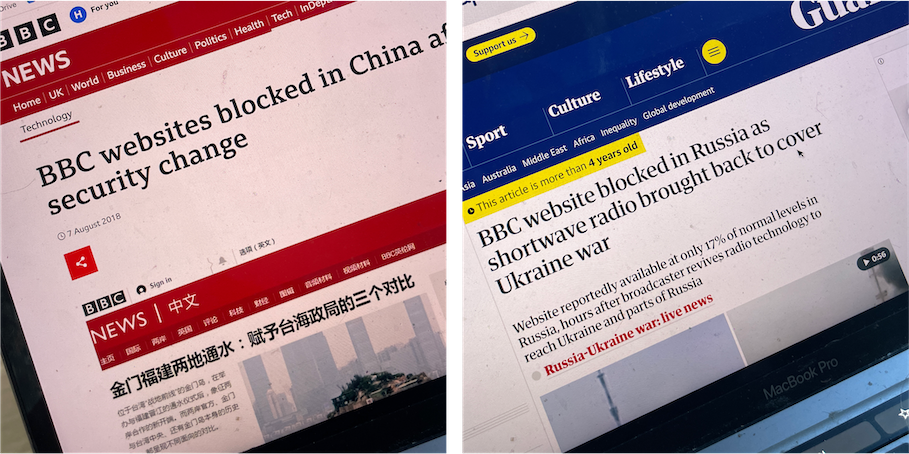
However, in practice, many states are still stifling access to information, and the free flow of independent news and journalism is heavily restricted. Internet freedom declined for the fifteenth consecutive year, according the Freedom House’s Freedom on the Net 2025 report. The state of press freedom globally was categorised as a “difficult situation” for the first time ever in RSF’s World Press Freedom Index 2025.
Read more: How Western governments are failing to support international public service media
Governments have a wide range of tools at their disposal to block audiences’ access to independent and fact-based news and information. They can impose firewalls, restricting access to certain websites and online content. They can institute blanket internet shutdowns, with the UN warning this tactic was on the rise. In the case of broadcast media, licences can also be revoked, suspended or terminated, preventing the distribution of content via TV or radio. For journalists, visas can be refused, access can be denied, or expulsion orders handed down, physically preventing any on-location reporting.
What do these circumstances mean for international public service media, with a credo to reach audiences with independent and fact-based news and information? The scenario does not result in international public media drawing back or reducing its coverage on particular regions, but instead requires greater investment, initiative and innovation to work their way around these blockages.
PMA’s Head of Content and Engagement discussed this topic with Jeff McCalla, Head of Distribution, BBC World Service and Abdallah Alsalmi, Policy Advisor on Internet Freedom and Governance, BBC World Service. They spoke of the lasting resiliency of shortwave, how VPNs are part of the solution, and whether there’s a place for international collaboration.
Harry Lock: The BBC recently announced it would be providing a shortwave radio service for Iran. Can you explain what goes into launching such a service from a technical standpoint?
Jeff McCalla: We have existing BBC and third-party shortwave transmitter resources available that we can utilise in emergencies for such broadcasts on short notice. We quickly establish which of the available transmitters would best serve the target audience we are trying to reach.
HL: There are also some examples from the past few years of other pop-up shortwave services from the BBC World Service. Why does this remain such a resilient and reliable technology? And is it irreplaceable? Will we always need it in some capacity?
JM: Broadcasting on shortwave, we can launch services on multiple frequencies from multiple locations at relatively short notice to provide a resilient service into the chosen target region or country. Shortwave transmissions are broadcast from outside the target country or territory, which means they are less likely to be disrupted by state authorities. That said, some countries, such as China and Iran, have invested heavily in broadcasting-jamming signals to prevent outside broadcasts landing in their territories. We are able to broadcast a digital signal over shortwave to provide a better listener experience, but the availability of affordable receivers is limited.
BBC Charter Review: The global value of the BBC
With the BBC Royal Charter review already underway, the Public Media Alliance asked fellow public service media to explain why the BBC plays such an important role internationally. Their responses were submitted in our full consultation response.
HL: From an editorial perspective, how is the decision made when and for who to create a shortwave service?
JM: The decision is usually based on audience survey data indicating there is an established shortwave audience for the target country.
HL: While it’s a good way of circumventing government blocks, it’s really essential that audiences are aware of the service in the first place. How do you build awareness amongst the target audience when reaching them via alternative means is difficult / impossible?
JM: We usually put out an international press release announcing and promoting the pop-up/lifeline service. Additionally, we will promote the new service via our other platforms such as TV, online and social media.
“As long as internet censorship and network interference are not prohibited at a global level … the BBC will continue to engage in a “cat and mouse game” of trying to reach our audiences globally.” – Abdallah Alsalmi, Policy Advisor on Internet Freedom and Governance, BBC World Service
HL: The BBC faces either partial or full blockages in China, Russia, and Iran. Are you aware of other countries where the BBC is blocked?
Abdallah Alsalmi: The BBC is being targeted by some internet service providers in Vietnam and Turkmenistan. In addition, it is unlikely that the BBC’s online services are accessible in North Korea, but this is more to do with restrictions affecting all websites.
HL: Are you able to monitor where you’re blocked? I know DW has the News Media Scan for example.
AAS: We use in-house dashboards to notice traffic drops to BBC websites and services. We also use some other open-source tools, such as the Open Observatory of Network Interference (OONI) and Google’s Censored Planet dashboards.
HL: When this happens, what are the steps the BBC takes to ensure audiences in those countries can still access the public service content they are otherwise not able to access?
AAS: We have Access to News pages in several languages on BBC websites and they include tools that our audiences distribute. We additionally procure circumvention tech from established providers. This allows users to download an application that can help in mitigating the blocking against BBC. Our editorial teams do use alternative delivery methods, such as social media, messaging apps and newsletters, where possible.



HL: The Freedom on the Net report shows that internet freedom continues to decline, with internet shutdowns a frequent tool deployed to quell unrest, but with severe implications. What are the tools that governments use to censor or shut down audiences’ access to independent news and information, and do you think they’re becoming more sophisticated?
AAS: There is a variety of tools that can be used to censor online content. Some governments seek to disrupt the ability of our audiences to reach our websites and use our apps. They do this by targeting the BBC domain itself in a way that redirects users to an error page rather than the BBC website itself. Some other governments, often with advanced capabilities, perform a deeper scanning of internet connections seeking BBC websites or apps and filter out or reset these connections so that a user cannot see the BBC page or, alternatively, they get a timeout error. This approach, which is known as Deep Packet Inspection (DPI), requires sophisticated equipment and resources.
Throttling is another resource-heavy technique which involves slowing down the user experience of BBC websites and apps to a grind, to the extent that they become unusable.
“There has been a number of cases where a radio frequency vacated by the BBC is then taken over by another broadcaster shortly thereafter. The expression “use it or lose it” springs to mind in this context.” – Jeff McCalla, Head of Distribution, BBC World Service
HL: What tools do international public media, and audiences, have in their arsenal to be able to circumvent such steps by governments?
AAS: VPN-like applications, also known as circumvention tools, allow audiences to access blocked BBC content. Although most VPNs are commercial, there is a set of solutions that are funded by grants from governments and corporate parties and are provided free of charge to users all over the world. Another unorthodox approach involves using satellite datacasting which allows for the delivery of offline content that can be downloaded from set-top boxes and the unpacked for viewing on TVs as well as other personal devices. Satellite internet services, such as Starlink, have gained traction over the past few years, particularly in countries and territories with total internet shutdowns (e.g. Iran, Gaza). But a service like Starlink requires a subscription and a physical terminal, which is not always affordable or procurable.
HL: Is there a challenge in that so much audience engagement happens through third-party platforms – what sort of dependency does this put on these platforms? And if IP is becoming the main method of reaching audiences, how vulnerable does it make public media to government internet shutdowns?
AAS: Audiences seek other platforms to get BBC News in various languages because they trust the BBC. As such, our language services rely on various platforms and at times, business interests might jeopardise the ability to serve BBC News content on a platform’s infrastructure, especially in a country where they have established business interests (e.g. Russia and China). Indeed, internet freedom is at the heart of complex political tech and business interests. While some companies do not respond to removal requests by some governments (e.g. from Iran), they might think twice about angering a big business environment like China or Russia. As long as internet censorship and network interference are not prohibited at a global level (similar to how harmful interference against satellite TV and shortwave radio signals is prohibited by the International Telecommunication Unions), the BBC will continue to engage in a “cat and mouse game” of trying to reach our audiences globally.
HL: There has been an emerging narrative of the huge investments into international media being made by the Chinese and Russian state, while for western democratically aligned media, it’s been a period of constriction. In real terms, what does this gulf mean for the services that the BBC World Service offers?
JM: There has been a number of cases where a radio frequency vacated by the BBC is then taken over by another broadcaster shortly thereafter. The expression “use it or lose it” springs to mind in this context.
HL: Are there opportunities for international public service media to work together and collaborate, to try and combat the threat from the Russian/Chinese/Iranian state media services? To ensure that audiences can access trusted, impartial, independent news and information?
JM: We do believe there are opportunities for international broadcasters to work together to share and develop technology solutions to counter state actors from disrupting and blocking free and independent news media being distributed to and consumed by audiences via linear and digital platforms. For example, several international broadcasters, including the BBC, launched in 2017 “Bypass Censorship”, an awareness- raising service that provides information on tools and applications that could be used to circumvent blocking of online news content. The US-funded Open Technology Fund (OTF) also helped international news outlets in initially deploying proxies of their websites onto the Tor Network, colloquially known as the dark web, to mitigate the problem of blocking. But the continuing dialogue, the exchange of lessons learnt, and early warnings among these broadcasters are among the most effective ways of responding to censorship. International broadcasters might appear to be competitors, but when it comes to internet freedom, we operate as partners.
About the interviewees

Jeff McCalla is Head of Distribution at the BBC World Service. He is a senior leader in service contracting, supplier partnerships and business operations within the broadcast and communications sector.

Abdallah Alsalmi is a Policy Advisor on Internet Freedom and Governance at the BBC World Service. He works on finding technical and policy solutions to enable international audiences access BBC News despite censorship and blocking.
Related Posts

BBC Charter Review: The global value of the BBC
With the Charter Review underway, we…

How Western governments are failing to support international public service media
Funding uncertainty clouds UK, Swiss…

Public service media help anchor reliable information
The contribution of public service…

PMA welcomes new funding arrangement for USAGM but challenges remain
Following presidential approval of the…