

ANALYSIS
Cuts, uncertainty & last-minute decisions: How Western governments are failing to support international public service media
4 March 2026
Funding uncertainty clouds international services from the UK, Switzerland and Germany. Is the recent funding of the USAGM likely to change things?
“We have no time to lose. As a country, we face big decisions about our role in the international arena.”
This was the stark warning presented to the UK government by the BBC’s outgoing director general, Tim Davie, at an event held in London in February. Seven weeks out from the BBC World Service’s current funding allocation running out, Davie was making an urgent plea for sufficient funding.
“I urge the government to back the World Service, to act decisively and confidently about what we can achieve in this space, and to act soon,” he said.
Read more: PMA welcomes new funding arrangement for USAGM but challenges remain (Statement)
A UK government spokesperson said it valued the work by the World Service, and that its funding settlement would be decided by the normal allocation procedure before the end of the financial year.
But the funding uncertainty the BBC World Service is experiencing is emblematic of the wider ecosystem of independent international public service media, one that is increasingly defined by funding insecurity and competition. All this, amid a time of unprecedented levels of investment by state actors with very different priorities.
Chinese and Russian state media continue to grow

According to BBC research, trust in Chinese and Russian international media services is on the rise; CGTN from 62 percent in 2021 to 70 percent in 2025; RT from 59 percent to 71 percent over the same time period. For comparison, trust in the BBC was the highest at 77 percent in 2025.
It has been known for some time that both states are investing heavily into their international media arms as a way of exerting influence. ABC International estimated that China alone spends around AU$9 billion (approx. £4.7 billion) a year on their media services. The BBC put the combined Chinese and Russian investment into media at £8 billion.
This manifests through cooperation agreements with local media, news bureaus, journalist training, and other methods. “I think it’s one very effective soft power tool because then it allows them to be able to use an easy resource,” said Beverly Ochieng, a security analyst with Control Risks, on PMA’s podcast last year. “Information is quite powerful: how you’re able to project information, whether it’s within the region or outside the region, and how you’re able to convey yourself and in some ways, earn some gratitude and at the same time earn a positive narrative across the region.”
The BBC study further established links towards consuming CGTN and RT, and having a favourable attitude towards China and Russia, to holding non-democratic values, and less of a preference for a democratic system of governance.
“Audiences consuming the Chinese state broadcaster, CGTN, and Russian state broadcaster RT, have a direct influence on their country’s respective favourability and trust is increasing,” said Fiona Crack, Global Director (Interim), BBC News, in a letter to Sir Geoffrey Clifton-Brown MP Chair of the Public Accounts Committee. “In order to combat mis- and disinformation and champion media freedom in a world of increased geopolitical instability, the BBC World Service requires long term, secure and sustainable funding.”
Listen to our podcasts on the global environment for international media
The ups and downs for international public service media
But if independent international public service and public interest media are the best counter to disinformation campaigns and propaganda, the message isn’t necessarily being understood, or acted upon, by policymakers.
The BBC World Service is far from the only independent international public service media organisation beset by funding troubles or uncertainty.
In Germany, for example, Deutsche Welle (DW), which has 337 million weekly users worldwide, is facing a funding cut of €10 million by Germany’s Federal Council, which will see 160 job losses. Such cuts will have a material impact, said the DW Broadcasting Council chair Karl Justen. “DW must remain a strong voice for freedom, especially in restricted media markets such as Russia and Iran. To do that, it needs reliable, long-term funding. Due to the cuts, the broadcaster will have to expect significant losses in reach.”
This funding cut could further damage DW’s future strategy to “be Europe’s leading voice for freedom,” as its director general, Barbara Massing outlined in October 2025. “To achieve this — especially amid widespread disinformation, the targeted use of artificial intelligence to spread fakes, growing uncertainty within liberal democracies and increasing digital isolation by authoritarian states — we need the resources to match.” These resources have shrunk, rather than expanded.

In Switzerland, meanwhile, the international public broadcaster has faced months of funding precariousness. The Swiss government, as part of a wider austerity package, proposed ending its funding for the international service SWI swissinfo.ch, which makes up half of its budget. Given other proposals to reduce the public media licence fee, which funds the other half of the budget, swissinfo was facing a fight for survival. The government’s proposal, however, was roundly rejected, first by the Senate in December, followed by the House of Representatives in March. Swissinfo is not completely clear yet though, and could still face budget cuts when the federal budget is finalised.
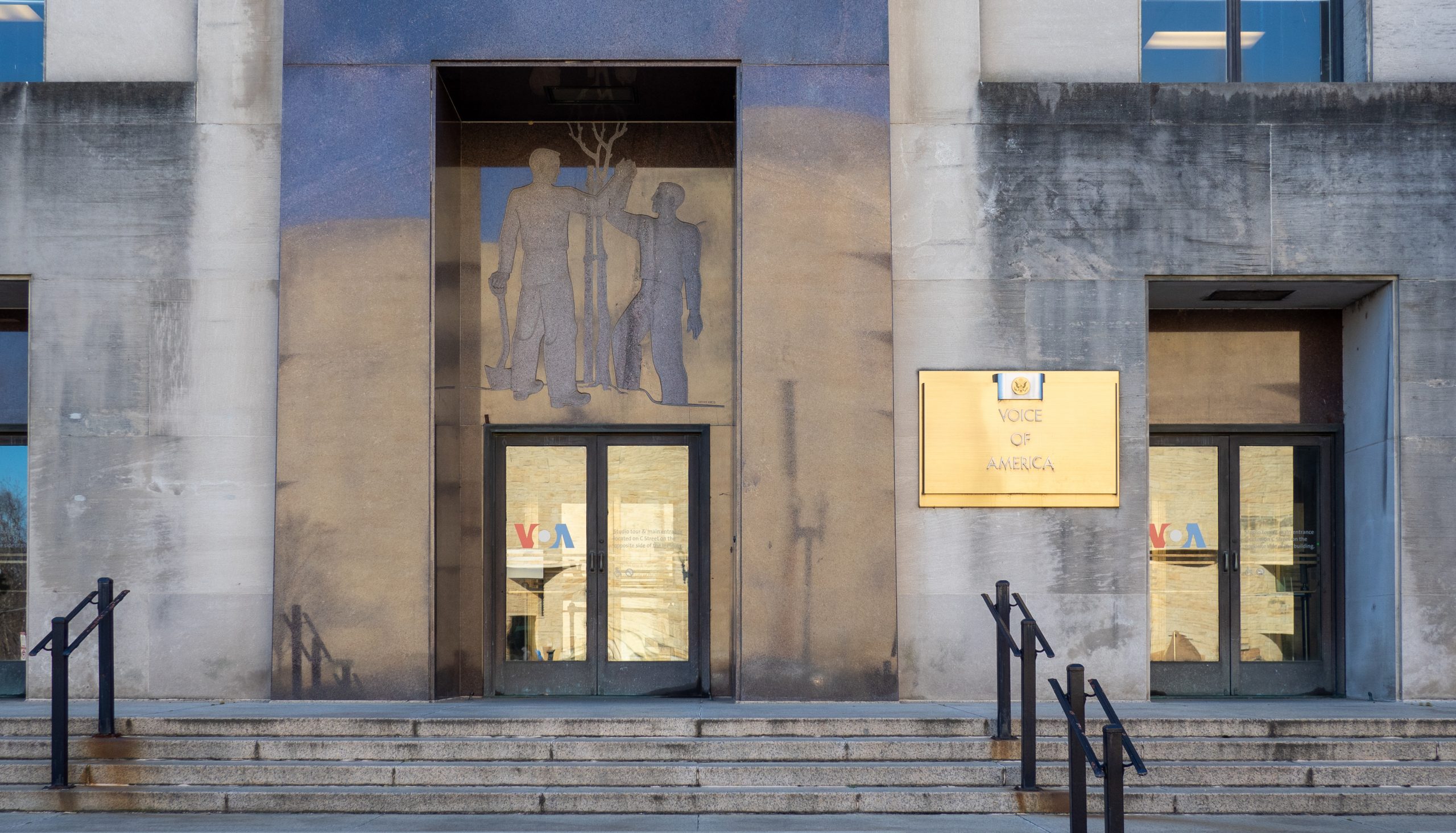
The most positive signal comes, perhaps surprisingly, from the US. The effective defunding of USAGM last year was a devastating blow to international journalism, leading to the closure of services, the loss of an international audience numbering in the hundreds of millions, and an untold impact on the many journalists who were employed by USAGM media companies. But this year, despite the Trump-appointed deputy CEO only asking for $160 million for the year ahead from Congress, a bipartisan bill in January provided USAGM with over $650 million in annual funds. This funding has already been used by Radio Free Asia (RFA) to relaunch language services across China. However, such funding might have come too late, as Balkan Insight reported that Radio Free Europe’s (RFE/RL) Romanian and Bulgarian services are to wind down at the end of March.
“DW must remain a strong voice for freedom, especially in restricted media markets such as Russia and Iran. To do that, it needs reliable, long-term funding. Due to the cuts, the broadcaster will have to expect significant losses in reach.” – DW Broadcasting Council chair, Karl Justen
What about other international public media services? For now, there are only hints rather than answers. NHK’s new president recently signalled a more outward, internationally focussed public broadcaster. Could this mean an enlarged presence for NHK World Japan? In Canada, the Carney government has promised governance and funding reforms for CBC/Radio-Canada. Could there be nuggets for a renewed international presence? And while ABC International’s budget got a four-year boost in 2022 under the current Albanese government, there are continuing calls for this to be stepped up as that funding period approaches its end.
More on International Public Media


Drops in the bucket
While the US situation appears to offer a glimmer of hope, there are multiple challenges remaining, and the Trump administration’s defunding of USAGM last year did significant damage that will not be easy to overcome. The reach of Voice of America (VOA), RFA, RFE/RL, and the others has dramatically declined. Audiences have had to turn elsewhere and aren’t guaranteed to return. The trust that employees and freelancers had in their employer is weakened. The strategic direction of the USAGM is now more overtly aligned with the White House, which will have implications for trust and independence, with reports that Trump officials are already seeking to “break editorial firewalls” according to The New York Times.
On top of this, the funding allocation that USAGM has been given is just over $650 million. This is $200 million less than USAGM was in line to receive in 2025, before the Trump administration ended their allocation. It still makes USAGM the best funded of all the other independent international public service media entities, but still well behind the Chinese and Russian state media.
Last year, there were calls, including from the Public Media Alliance, to recognise the intrinsic value of international public media in providing independent and fact-based news and information to underserved and isolated audiences, often in closed and anti-democratic states. This role is facing an existential challenge in the form of much better-funded and increasingly trusted but inherently anti-democratic state media. Those calls, to match the recognition with ample and sustainable funding, appears to have gone unheeded with stark implications for the flow of and access to trusted, independent sources of news and information globally.
Related Posts

PMA welcomes new funding arrangement for USAGM but challenges remain
Following presidential approval of the…

PMA opposes proposal to cut funding for Swiss public media
Ahead of the Swiss referendum on…

Head of ABC International on Australia’s role in the Pacific
Claire Gorman on ABC International's…

PMA submission in support of Switzerland’s international public media
In April, PMA responded to the Swiss…