

The PMA Briefing
A renewed international focus; concern over political interference
3 February 2026
NHK’s new president has promised an enhanced international presence; meanwhile, there are concerns over Belgium’s Francophonie media minister’s approach to appointing the next CEO of RTBF, and Bangladeshi civil society is alarmed at broadcast and media reform two weeks out from an election. Plus: government intervention in Argentine national broadcasting is extended again, and what’s the response to Poland’s broadcasting act amendments?
Japan: New NHK president promises enhanced international presence & solid finances
An enhanced international presence and more secure funding are the priorities for NHK’s new president. The commitments were outlined in President Inoue Tatsuhiko’s first press conference since coming into the role on 25 January.
Amidst rapid changes in the global media industry, “whether or not an organisation can consistently produce high-quality content directly impacts its value as a public media outlet,” he said. “I believe that the key to NHK’s sustainability lies in dramatically strengthening our content development, dissemination, and international expansion capabilities.” For NHK, he said this would mean taking “an even more aggressive approach than before to developing new IP and intellectual property, linking digital with broadcasting, and developing programs from a global perspective.”
Inoue also spoke about shoring up NHK’s financial situation. Last year, NHK posted a 40 billion yen deficit due to a shortfall in licence fee payments. However, he said they were on track to breakeven by FY 2027, and said they have made progress in reducing operating expenses, while they are also hoping to “curb the increase in unpaid receiving [licence] fees”. However, while other public broadcasters consider a move away from such a model, Inoue said he still felt it is “the best system for NHK as a public broadcaster to fulfill its role of delivering accurate, fair and impartial information to a wide variety of people nationwide, without being influenced by specific interests or viewer ratings.” It comes after the launch of NHK One – an internet-based domestic online platform which costs the same as the receiving fee – in September 2025, as a device-independent system of ensuring users pay for NHK services.
Inoue was an internal appointment to NHK. He previously served as vice president, and also headed the political news division. He will serve a three-year term.
Belgium: Media minister “regrets” implications of political interference over appointments
The Francophone media minister has faced criticism after she welcomed the forthcoming departure of RTBF’s longstanding CEO and the director of news, and strongly indicated she would use the new appointments to bring a different editorial line to the independent public service broadcaster.
On 13 January, during a meeting of activists from the liberal-conservative party MR, the minister Jacqueline Galant welcomed the imminent departure of the two senior RTBF officials. “We hope that with these two changes we can bring a slightly different (editorial) line, one that will go to the other side of the political spectrum,” she said. “It’s time for a change. These people have been there for too long. A system has become entrenched.”
However, the comments triggered a reaction from RTBF, as well as journalists groups and political opposition. In a statement, the public broadcaster said “We accept criticism and public debate, but we refuse any form of interference. We condemn any statement that undermines the editorial independence of the public broadcaster, whether in terms of its structure, its missions, its values, or its staff.” Her comments were also criticised by the Belgian journalists’ union as well as the Minister-President of the Wallonia-Brussels Federation. However, the president of her party said she had nothing to apologise for, and also called for a parliamentary commission into public broadcasting.
In the days after, Galant said she “regrets the controversy” and would “respect … the legal requirements and the internal procedures of RTBF” which govern the appointments process.

Bangladesh: Proposals for new media & broadcasting commission met with concern
The interim government has announced proposals to create two separate regulatory bodies to oversee media policy in Bangladesh – a media commission and a broadcasting commission – but the move has been criticised by journalist groups.
The broadcasting commission will be made up of five individuals, including three from the government (the cabinet secretary, the information ministry secretary, and a third secretary) as well as two individuals with 15 years of experience in broadcasting. The commission will be responsible for creating and overseeing broadcasting policy as well as broadcasting licences and have the power to issue fines and revoke licences.
Meanwhile, the directive for the media commission proposes a nine-person commission, including a chair. At least one woman and one member of an ethnic minority must be included. Two journalists with 20 years experience, one professor in media, and the cabinet secretary must be included, and it would be led by a judge. The media commission is intended to be a self-regulatory body for the media, upholding professional standards.
Both directives appear to be an attempt from the interim government to follow up on the Media Reform Commission, established by the interim government after the overthrow of the Sheikh Hasina administration. However, none of the recommendations have yet been fulfilled. The proposals have been met with concern from some. The Editors’ Council said they threaten media independence, and said such policies should wait until after an elected government has come into power, with Bangladesh due to hold elections later this month. Article 19 meanwhile expressed concern about the rushed timetable to push the proposals through, with only three days provided for feedback, while the actual proposal “lacks transparency and due process and risks undermining freedom of expression.” Both commissions would be under “direct government control”, the advocacy organisation said.
Argentina: Two extensions and counting – government continues intervention in public media
The Argentinian government has once again extended its intervention into the country’s public media, prolonging its oversight of Radio y Televisión Argentina (RTA) and Contenidos Artísticos e Informativos SAU until February 2027. Initially introduced in February 2024 for an initial one-year period, the measure was designed to give the government powers to reform the organisations. It was first extended in 2025, and now, the government said the latest renewal is justified by pointing to the Executive Board’s assessment of the progress made in the broadcasters’ reorganisation process.
Carlos María Curci González has been confirmed to continue leading the intervention, arguing that additional time is needed to complete ongoing restructuring efforts and to strengthen the “operational capabilities” of broadcasters.
The extension, however, has sparked strong criticism from journalists, who accused the government of undermining the independence and democratic value of public media. They argue that the administration failed to engage in discussions about improving broadcasters and the importance of their role in a democratic society, pointing to the shutdown of public news agency Télam as evidence of a wider rollback of media plurality in Argentina.

Poland: Broadcasting law reforms welcomed but risk of funding freeze for public media
Organisations are calling for a rethink of public media funding in Poland, after proposals to reform the licence fee would leave the country’s public broadcasters as among the least well-funded in Europe.
The arguments were made during the public consultation into the draft reforms to the current Polish Broadcasting and Television Act, which has recently ended. The draft law aims to implement the principles of the European Media Freedom Act into Polish national media laws. The reforms include reforming the media regulator, the KRRiT, increasing the number of its members and expanding its mandate. Another key element of the drafted law is the dissolution of the National Media Council, a controversial oversight body set up by the Law and Justice (PiS) party in 2016. Its authority to appoint supervisory boards and management for public media would be reverted to the KRRiT.
The amendments were cautiously welcomed by participating organisations, including IPI and the ECPMF, considering it a “positive but incomplete” initiative to improve Polish media law and provide sufficient safeguard for free and independent media in Poland.
One key concern, however, was the funding of public media organisations. Under the draft amendment, the licence fee model would be abolished, and the funding mechanism would shift to an integrated tax model, setting a 2.5 billion PLN (€590 million) revenue for public media per year for 2027–2036. The EBU as well as the Media Freedom Rapid Response consortium said that freezing public media funding for a long period of time would not take into account inflation and rising production costs, which would gradually weaken public media. Additionally, the yearly 2.5 billion PLN budget would make Polish public media one of the least-funded public broadcasters in Europe.
The same organisations called on Polish authorities to provide a sufficient and sustainable funding system for TVP and Polskie Radio in the amended broadcasting act.
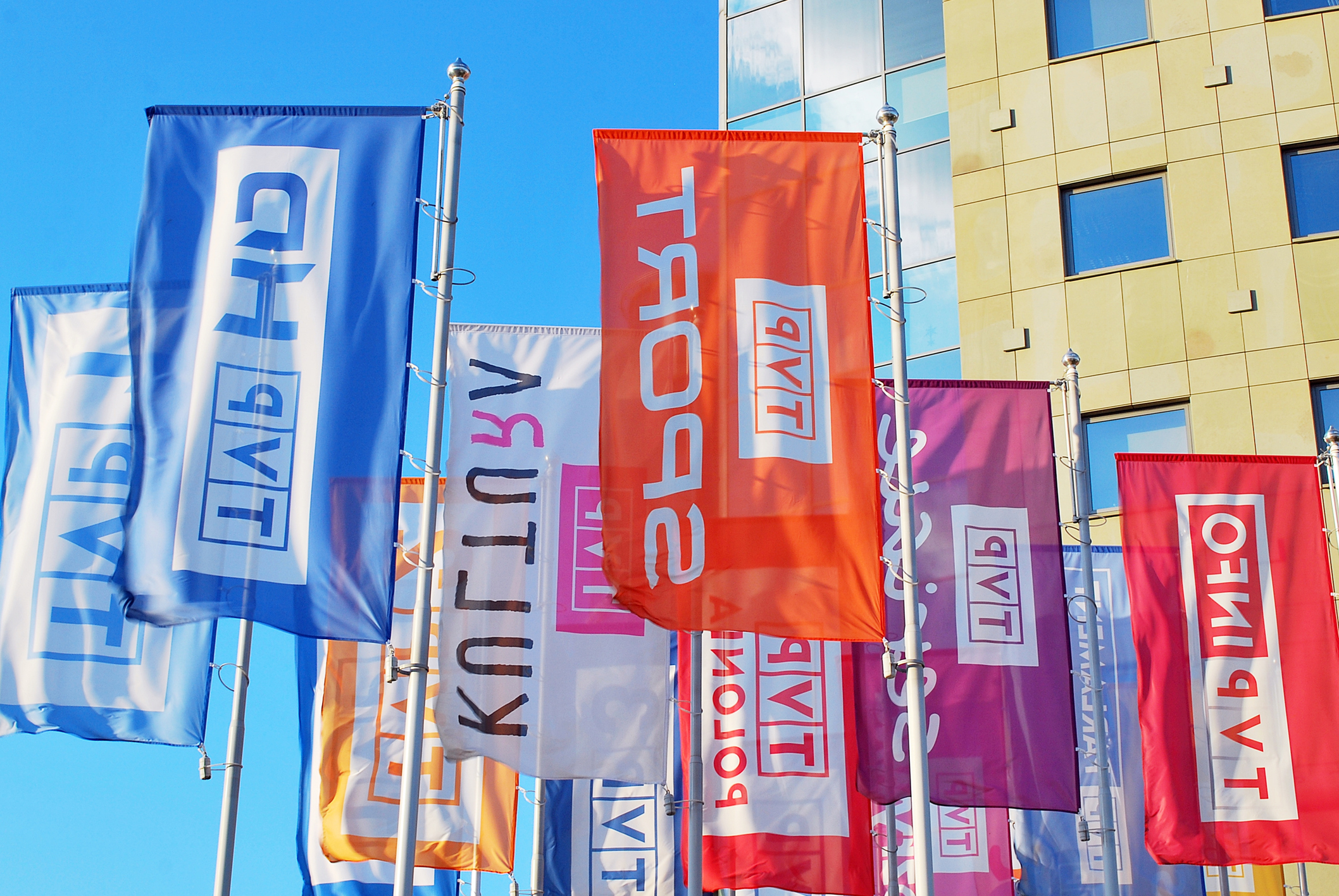
Featured image: Flags of different channels in front of one of the buildings of Polish Television (TVP) in Warsaw. Credit: fotokon/iStock
Related Posts

Financial crisis, clarity on reforms, and strikes called off | The PMA Briefing
BHRT is mired in a financial hole; from…

Lay offs, shut downs & appointments | The PMA Briefing
RTM and Bernama join Malaysia’s Media…
Legal filings, a public media levy, and must-carry obligations | The PMA Briefing
Filings from the BBC seek to have the…
Standoffs, closures, and reforms | The PMA Briefing
CPB votes to dissolve; RTS unions in…