

Journalism Thrives in Slovakia Despite Growing Oligarchic Control
REPORT
Journalism Thrives in Slovakia Despite Growing Oligarchic Control
Center for Media, Data and Society | Central European University
Published: May 2020
Slovaks have access to a plethora of news platforms, but many of them are in the hands of powerful financial corporations, closely linked with political groups. Nevertheless, swelling demand for accurate, quality information boosts the country’s independent journalism.
Slovakia is a voracious news consumer, with almost two thirds of people reading news portals, newspapers or news magazines. Much of this news appetite was stirred by technological advancement. Over 86% of people use the internet, which is a big leap from less than 30% in the beginning of the 2010s…
Text sourced from CMDS | CEU

Small Screen: Big Debate
WEBSITE
Small Screen: Big Debate
Ofcom
2020
Join the conversation on the future of public service broadcasting in the UK
This website will allow you to access a wide variety of research, learn more of our work in this area and submit your views directly to us on the future of public service broadcasting and media.
Reporting facts: free from fear or favour
REPORT
Reporting Facts: Free from fear or favour
UNESCO | Marius Dragomir
Published: 2020
Preview of In Focus report on World Trends in Freedom of Expression and Media Development
Countering Disinformation
WEBSITE
Countering Disinformation
Cardiff University | Arts and Humanities Research Council
2020
“Disinformation is a growing risk to the health of many democratic systems. Funded by the Arts and Humanities Research Council, this project will assess how leading UK public service media are counteracting it in news reporting.”
This project is the largest of its kind in the UK and focusses on the content produced by The BBC, Channel 4 ITV and Sky News. It aims to provide a “comprehensive understanding of how British public service media and audiences are developing practices to address and counter disinformation. “
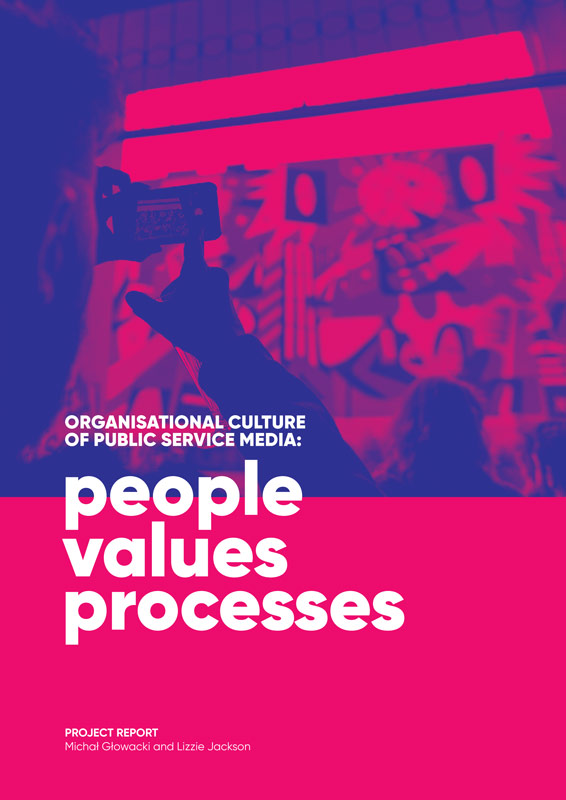
Organisational Culture of Public Service Media: People, values, processes
REPORT
Organisational Culture of Public Service Media: People, values, processes
Dr Michał Głowacki and Professor Lizzie Jackson
2019
In 2015-2019 Dr Michał Głowacki and Professor Lizzie Jackson investigated the internal organisational cultures of ten successful high technology clusters in North America and Europe to identify strategies to support the evolution of Public Service Media worldwide.
Four media clusters were located in North America: Austin (Texas), Boston/Cambridge (Massachusetts), Detroit (Michigan) and Toronto (Canada). European clusters included London (UK), Warsaw (Poland), Copenhagen (Denmark), Brussels (Belgium), Tallinn (Estonia), and Vienna (Austria). To answer the question ‘what people, values and processes’ should Public Service Media embody going forward we found there is an urgent need for adaptation. Without internal change there is likely to be a decline in the ability of PSM to survive within the fast-evolving contemporary media and communications production and distribution landscape.
Universalism in Public Service Media
Book
Universalism in Public Service Media
RIPE@2019
Edited by Philip Savage, Mercedes Medina, Gregory Ferrell Lowe
Published by Nordicom
Since the start of telephony and later in broadcasting, the pursuit of universal service has legitimated the ownership and operation of media as a public trust.
Until the 1980s, this principle was the bedrock for the broadcasting mission and is still a mandated requirement for public media companies today. But in practice, the universalism ideal was largely abandoned in the 1980s as media deregulation promised more competition, innovation, and vigorous economic growth. Some of this came true, but at a worrisome cost. Growing distrust in media today is partly rooted in the illusion that more media in more platforms would inevitably ensure better media in all platforms. There is now more of everything on offer except social responsibility. This collection interrogates the historic universalism mission in public service broadcasting and explores its contemporary relevance for public service media. Taking a critical perspective on media policy and performance, the volume contributes to a much-needed contemporary reassessment that clarifies the importance of universalism for equity in access and provision, trustworthy content, and inclusive participation in the context of advancing digitalisation and globalisation. The collection situates universalism as an aspirational quest and inspirational pursuit. Researchers and policy makers will find the collection valuable for conceptualisation and strategic managers will find it helpful as a principled basis in the pursuit of improved reach and value.
(Text sourced via RIPE & Nordicom)
Gender Equality and Diversity Implications of COVID-19 Crisis for Public Service Media
REPORT
Gender Equality and Diversity Implications of COVID-19 Crisis for Public Service Media
European Broadcasting Union
What have been the gender and diversity implications of COVID-19 for media?
“36 professionals from 24 EBU Member organisations gathered on 6 April for a virtual roundtable to discuss 5 signposted issues and share their strategies in addressing them during these unprecedented times…” – EBU
Routes to Content: how people decide what TV to watch
REPORT
Routes to Content: how people decide what TV to watch
With more than half of UK households owning an internet-connected TV and subscribed to at least one SVOD, this article sought to analyse how people discover and decide what television to watch and explore just how accessible public service television is.
“The contemporary media landscape has altered the discoverability of television content. More than half of UK households have a TV set connected to the internet and subscribe to at least one subscription video-on-demand (SVOD) service, multiplying the routes that people can take to find the television programmes that they want to watch.
For the television industry, this means adopting new strategies to increase the discoverability and accessibility of their content. For regulators and policymakers, this challenges existing prominence legislation that aims to ensure that public service content is easy to find. Current prominence regulations were designed for the world of linear television channels and electronic programme guides, raising the question of how accessible public service television is in the new on-demand environment.”
News media broadly trusted, views of UK government response to COVID-19 highly polarised
News media broadly trusted, views of UK government response to COVID-19 highly polarised
REPORT
This Reuters Institute factsheet is the first of the UK COVID-19 news and information project and explores how people navigate news and information in the UK during the COVID-19 pandemic.
“In this RISJ Factsheet we examine people’s attitudes towards how news organisations, government and other institutions are responding to the coronavirus pandemic in the UK based on a survey fielded from 10 April to 14 April.” – Reuters Institute for the Study of Journalism
Types, sources, and claims of COVID-19 misinformation
Types, sources, and claims of COVID-19 misinformation
REPORT & WEBSITE
A Reuters Institute factsheet identifying some of the main types of misinformation shared during the COVID-19 pandemic
“In this factsheet we identify some of the main types, sources, and claims of COVID-19 misinformation seen so far. We analyse a sample of 225 pieces of misinformation rated false or misleading by fact-checkers and published in English between January and the end of March 2020, drawn from a collection of fact-checks maintained by First Draft.” – Reuters Institute.