

The Reuters Institute Digital News Report 2021
REPORT
Reuters Institute Digital News Report 2021
10th Edition
Reuters Institute for the Study of Journalism, University of Oxford | Nic Newman with Richard Fletcher, Anne Schulz, Simge Andı, Craig T. Robertson, and Rasmus Kleis Nielsen
Published: 2021
This year’s report reveals new insights about digital news consumption based on a YouGov survey of over 92,000 online news consumers in 46 markets including India, Indonesia, Thailand, Nigeria, Colombia and Peru for the first time.
The report looks at the impact of coronavirus on news consumption and on the economic prospects for publishers. It looks at progress on new paid online business models, trust and misinformation, local news, impartiality and fairness in news coverage.
[Text sourced from the Reuters Institute]

Are public service media distinctive from the market?
JOURNAL
Are public service media distinctive from the market?
Interpreting the political information environments of BBC and commercial news in the United Kingdom
Cardiff University | Stephen Cushion
Published: 2021
Public service media face an existential crisis. Many governments are cutting their budgets, while questioning the role and value of public service broadcasting because many citizens now have access to a wide range of media. This raises the question – do public service media supply a distinctive and informative news service compared to market-led media? Drawing on the concept of political information environment, this study makes an intervention into debates by carrying out a comparative content analysis of news produced by UK public service broadcasters and market-driven media across television, radio and online outlets (N = 1065) and interviewing senior editors about the routine selection of news. It found that almost all BBC news and commercial public service media platforms reported more news about politics, public affairs and international issues than entirely market-driven outlets. Online BBC news reported more informative topics than market-based media, which featured more entertainment and celebrity stories. The value of public service media was demonstrated on the United Kingdom’s nightly television news bulletins, which shone a light on the world not often reported, especially BBC News at Ten. Most market-driven media reported through a UK prism, excluding many countries and international issues. Overall, it is argued that the influence of public service media in the United Kingdom helps shape an information environment with informative news. The focus of the study is on UK media, but the conceptual application of interpreting a political information environment is designed to be relevant for scholars internationally. While communication studies have sought to advance more cross-national studies in recent years, this can limit how relevant studies are for debates in national political information environments. This study concludes by recommending more scholarly attention should be paid to theorising national policy dynamics that shape the political information environments of media systems within nations.
[Text sourced from the SAGE]
The Missing Middle: Reimagining a Future for Tweens, Teens, and Public Media
REPORT
The Missing Middle
Reimagining a Future for Tweens, Teens, and Public Media
The Joan Ganz Cooney Center at Sesame Workshop, The Corporation for Public Broadcasting | Monica Bulger, Mary Madden, Kiley Sobel, Patrick Davison
Published: 2021
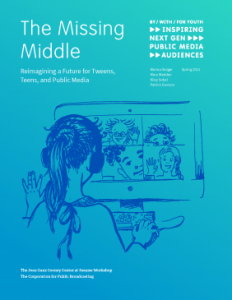
The Joan Ganz Cooney Center and the Corporation for Public Broadcasting have partnered to better understand how young people are engaging with media today in order to help public media better serve Gen Z. As part of our By/With/For Youth: Inspiring Next Gen Public Media Audiences, we spoke with tweens and teens across the U.S. about how they spend their time, what they find interesting, how they find new shows, apps, or videos, what issues are important to them, as well as what misconceptions adults have about youth. We asked them for their advice about what media producers should do if they want to engage with people their age, and how their lives have changed during the pandemic.
The report features the voices of a generation of youth who crave authenticity and who want to be more than passive consumers in this rapidly changing media landscape. The participating 10-17-year-olds described how they seamlessly move across platforms and devices depending on their moods, interests, and access to certain kinds of connectivity.
[Text sourced from the Joan Ganz Cooney Center]
Public service media in Europe: law, theory and practice
Book
Public service media in Europe
Law, Theory and Practice
Routledge | Karen Donders
Publication date: June 2021
Contributing to a rethink of Public Service Media, this book combines theoretical insights and legal frameworks with practice, examining theory and policy development in a bottom-up manner.

It explores the practices of Public Service Media across Europe, assessing the rules that govern Public Service Media at both the EU and the National Member State level, identifying common trends, initiated by both the European Commission and individual countries, illustrating the context-dependent development of Public Service Media and challenging the theories of Public Service Broadcasting which have developed an ideal-type public broadcaster based on the well-funded BBC in an atypical media market. Seeking to further explore the actual practices of Public Service Media and make recommendations for the development of more sustainable policies, this book offers case studies of rules and practices from across a variety of EU Member States to consider the extent to which public broadcasters are making the transition to public media organisations, and how public broadcasters and governments are shaping Public Service Media together.
This book is a must-read for all scholars who take an interest in Public Service Media, media policy and media systems literature at large. It will also be of interest to practitioners working in government, Public Service Media and commercial media.
(Text sourced via Routledge)
Online violence Against Women Journalists: A Global Snapshot of Incidence and Impacts
REPORT
Online violence Against Women Journalists
A Global Snapshot of Incidence and Impacts
United Nations Educational, Scientific, Cultural Organization | Julie Posetti, Nermine Aboulez, Kalina Bontcheva, Jackie Harrison, and Silvio Waisbord
Published: 2020
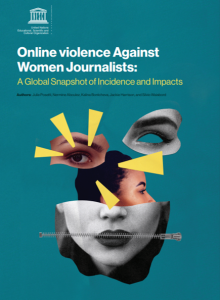
This report presents a snapshot of the first substantial findings from a global survey about online violence against women journalists conducted by UNESCO and the International Center for Journalists (ICFJ) in late 2020. Over 900 validated participants from 125 countries completed the survey in Arabic, English, French, Portuguese and Spanish. The findings shared here reflect the input of the 714 respondents identifying as women.
[Text sourced from UNESCO/ICFJ]
Covid-TV: Routes to Content during Covid-19
POLICY BRIEF
Covid-TV
Routes to Content during Covid-19
University of Huddersfield | Prof. Catherine Johnson
Published: 2020
What does the impact of Covid-19 on TV viewing tell us about the future of public service broadcasting (PSB) in the UK?
Shining a Spotlight on Media Freedom?
REPORT
Shining a Spotlight on Media Freedom?
Media Coverage of the Global Campaign for Media Freedom
City, University of London; University of East Anglia | Martin Scott, Mel Bunce, Mary Myers
Published: 2020
In our first project report, we analyse English-language, online news coverage and Twitter commentary about media freedom. Specifically, we ask whether the Global Campaign for Media Freedom (GCMF) has succeeded in ‘shining a spotlight’ on media freedom in its first year of activities, from July 2019- July 2020.
Funding Journalism in Israel: Secrecy and Political Influence
WEBSITE
Funding Journalism in Israel: Secrecy and Political Influence
Center for Media, Data and Society | Central European University
Published: June 2020
Unusual opacity is the most salient characteristic of the media system in Israel, where the involvement of political figures in media operation raises serious concerns.
At first glance, the Israeli media market seems a diverse mix of old and new, public and commercial, cable and satellite, and increasingly dominant, if not ubiquitous, digital media. But beneath the appearance of this growing diversity, there is little pluralism…
Text sourced from CMDS | CEU

Who Finances India’s Journalism?
REPORT
Who Finances India’s Journalism?
Center for Media, Data and Society | Central European University
Published: June 2020
Commercial advertisers are the largest players in terms of funding spent in the media in India, but the state has also a significant role, financing the country’s public service broadcaster, shelling out public advertising money to commercial media and holding a monopoly over the news radio market.
The news media market in India is regionally and linguistically fragmented but ownership is concentrated within a handful of large players, more so in regional geographies. It is significant that the news business is largely run and owned by individuals (and families) with primarily non-media business interests and assets…
Text sourced from CMDS | CEU
Soft Power, Hard News: How Journalists at State-Funded Transnational Media Legitimize Their Work
JOURNAL
Soft Power, Hard News: How Journalists at State-Funded Transnational Media Legitimize Their Work
Kate Wright, Martin Scott, Mel Bunce | Sage Journals
Published: May 2020
How do journalists working for different state-funded international news organizations legitimize their relationship to the governments which support them? In what circumstances might such journalists resist the diplomatic strategies of their funding states?
We address these questions through a comparative study of journalists working for international news organizations funded by the Chinese, US, UK and Qatari governments. Using 52 interviews with journalists covering humanitarian issues, we explain how they minimized tensions between their diplomatic role and dominant norms of journalistic autonomy by drawing on three – broadly shared – legitimizing narratives, involving different kinds of boundary-work. In the first ‘exclusionary’ narrative, journalists differentiated their ‘truthful’ news reporting from the ‘false’ state ‘propaganda’ of a common Other, the Russian-funded network, RT. In the second ‘fuzzifying’ narrative, journalists deployed the ambiguous notion of ‘soft power’ as an ambivalent ‘boundary concept’, to defuse conflicts between journalistic and diplomatic agendas. In the final ‘inversion’ narrative, journalists argued that, paradoxically, their dependence on funding states gave them greater ‘operational autonomy’. Even when journalists did resist their funding states, this was hidden or partial, and prompted less by journalists’ concerns about the political effects of their work, than by serious threats to their personal cultural capital.