

The Public Service Approach to Recommender Systems
JOURNAL
The Public Service Approach to Recommender Systems: Filtering to Cultivate
Jockum Holden | Television & New Media Journal
2022
The use of algorithms that recommend content to their users has dramatically transformed online media consumption. PSM is catching on and have adopted these algorithms into their own systems to personalise how their online content is distributed. However, since these algorithms cater to a more commercialised recommending system, it could make them incompatible with PSM values, which is to disseminate diverse content. This study gives an in-depth knowledge of how PSM have modified these recommender systems to suit a non-commercial setting.

The Missing Middle: Reimagining a Future for Tweens, Teens, and Public Media
REPORT
The Missing Middle
Reimagining a Future for Tweens, Teens, and Public Media
The Joan Ganz Cooney Center at Sesame Workshop, The Corporation for Public Broadcasting | Monica Bulger, Mary Madden, Kiley Sobel, Patrick Davison
Published: 2021
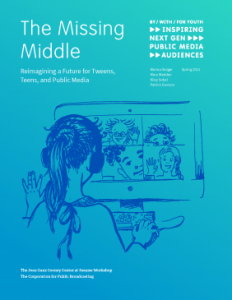
The Joan Ganz Cooney Center and the Corporation for Public Broadcasting have partnered to better understand how young people are engaging with media today in order to help public media better serve Gen Z. As part of our By/With/For Youth: Inspiring Next Gen Public Media Audiences, we spoke with tweens and teens across the U.S. about how they spend their time, what they find interesting, how they find new shows, apps, or videos, what issues are important to them, as well as what misconceptions adults have about youth. We asked them for their advice about what media producers should do if they want to engage with people their age, and how their lives have changed during the pandemic.
The report features the voices of a generation of youth who crave authenticity and who want to be more than passive consumers in this rapidly changing media landscape. The participating 10-17-year-olds described how they seamlessly move across platforms and devices depending on their moods, interests, and access to certain kinds of connectivity.
[Text sourced from the Joan Ganz Cooney Center]

Covid-TV: Routes to Content during Covid-19
POLICY BRIEF
Covid-TV
Routes to Content during Covid-19
University of Huddersfield | Prof. Catherine Johnson
Published: 2020
What does the impact of Covid-19 on TV viewing tell us about the future of public service broadcasting (PSB) in the UK?
Journalism Thrives in Slovakia Despite Growing Oligarchic Control
REPORT
Journalism Thrives in Slovakia Despite Growing Oligarchic Control
Center for Media, Data and Society | Central European University
Published: May 2020
Slovaks have access to a plethora of news platforms, but many of them are in the hands of powerful financial corporations, closely linked with political groups. Nevertheless, swelling demand for accurate, quality information boosts the country’s independent journalism.
Slovakia is a voracious news consumer, with almost two thirds of people reading news portals, newspapers or news magazines. Much of this news appetite was stirred by technological advancement. Over 86% of people use the internet, which is a big leap from less than 30% in the beginning of the 2010s…
Text sourced from CMDS | CEU

Small Screen: Big Debate
WEBSITE
Small Screen: Big Debate
Ofcom
2020
Join the conversation on the future of public service broadcasting in the UK
This website will allow you to access a wide variety of research, learn more of our work in this area and submit your views directly to us on the future of public service broadcasting and media.
Routes to Content: how people decide what TV to watch
REPORT
Routes to Content: how people decide what TV to watch
With more than half of UK households owning an internet-connected TV and subscribed to at least one SVOD, this article sought to analyse how people discover and decide what television to watch and explore just how accessible public service television is.
“The contemporary media landscape has altered the discoverability of television content. More than half of UK households have a TV set connected to the internet and subscribe to at least one subscription video-on-demand (SVOD) service, multiplying the routes that people can take to find the television programmes that they want to watch.
For the television industry, this means adopting new strategies to increase the discoverability and accessibility of their content. For regulators and policymakers, this challenges existing prominence legislation that aims to ensure that public service content is easy to find. Current prominence regulations were designed for the world of linear television channels and electronic programme guides, raising the question of how accessible public service television is in the new on-demand environment.”
News media broadly trusted, views of UK government response to COVID-19 highly polarised
News media broadly trusted, views of UK government response to COVID-19 highly polarised
REPORT
This Reuters Institute factsheet is the first of the UK COVID-19 news and information project and explores how people navigate news and information in the UK during the COVID-19 pandemic.
“In this RISJ Factsheet we examine people’s attitudes towards how news organisations, government and other institutions are responding to the coronavirus pandemic in the UK based on a survey fielded from 10 April to 14 April.” – Reuters Institute for the Study of Journalism
Trust in Media
REPORT
Trust in Media
Public Service Media are the most trusted source for news in 61% of European countries according to this EBU report.
European Broadcasting Union
“This report brings you insights on how people are turning to public service media news content as an essential trusted source at a time of crisis such as COVID-19.”
The new 2020 Trust in Media report includes an infographic and the dataset. Open access, login required.
Old, Educated, and Politically Diverse
REPORT
Old, Educated, and Politically Diverse
The Audience of Public Service News
Anne Schulz, David A. L. Levy, and Rasmus Kleis Nielsen – Reuters Institute for the Study of Journalism
Abstract
Public service media are often widely used, highly trusted, and do not face the business pressures with which their private peers have to contend. But a closer look suggests that the challenges that face public service media news provision are bigger – much bigger – than is commonly acknowledged, even in countries with a long history of strong public service media. This report analyses survey data from a sample of eight countries to assess the reach of public service news. It finds that the audience for public service news is old, educated, and politically diverse, and that public service media in many countries fall far short of the ambition to provide a near-universal news service, especially online. While they are among the most widely trusted news sources, they are often less trusted by people on the political right and people with populist attitudes.
Public Service Broadcasting in the Digital Age
JOURNAL
Public Service Broadcasting in the Digital Age
Journal of European Television History and Culture. Volume 8 – Issue 16 – 2019. Special Issue
Jérôme Bourdon, Mette Charis Buchman and Peter B. Kaufman (eds.)
Abstract:
This special issue proposes a reexamination of public service broadcasting (PSB) in the light of the most recent technological, political and economic developments. Traditional public service broadcasters, ideally designed to serve citizens rather than consumers to inform the national conversations in well-informed democracies, face the double challenge of commercialization (since the 1980s) and digitization (since the 1990s). The question of their survival in this context has been posed again and again. The need for a redefinition seems inevitable.