

Organisational Culture of Public Service Media
REPORT
Organisational Culture of Public Service Media
People, Values and Processes (2015–2019)
Michal Glowacki and Lizzie Jackson
Abstract
In 2015-2019 Dr Michał Głowacki and Professor Lizzie Jackson investigated the internal organisational cultures of ten successful high technology clusters in North America and Europe to identify strategies to support the evolution of Public Service Media worldwide. Four media clusters were located in North America: Austin (Texas), Boston/Cambridge (Massachusetts), Detroit (Michigan) and Toronto (Canada). European clusters included London (UK), Warsaw (Poland), Copenhagen (Denmark), Brussels (Belgium), Tallinn (Estonia), and Vienna (Austria). To answer the question ‘what people, values and processes’ should Public Service Media embody going forward we found there is an urgent need for adaptation. Without internal change there is likely to be a decline in the ability of PSM to survive within the fast-evolving contemporary media and communications production and distribution landscape.

Public service broadcasting: as vital as ever
REPORT
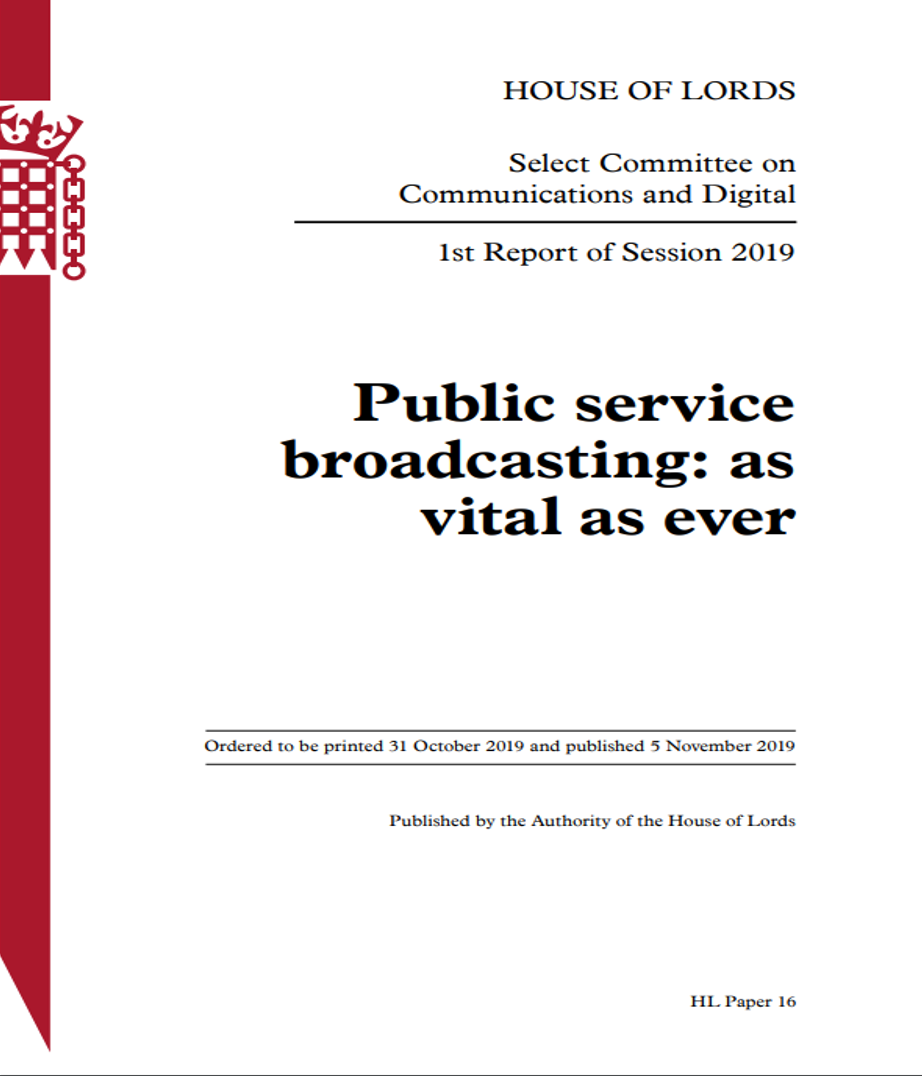
Public service broadcasting: as vital as ever
By The UK House of Lords Select Committee on Communications

The House of Lords report on public service broadcasting in the age of video on demand concludes that PSBs are vital and in need of better support to produce high quality content and programming. But they also need to adapt to the changing media landscape in order to better serve audiences.
The report also reveals that public service broadcasting remains prominent within the UK and is a driver of the creative economy. Recommendations include the establishment of a new body called the BBC Funding Commission and to ensure that deals and plans are conducted with more transparency.
Read the PMA response to this report here.

Public Service Media & Digital Innovation: The Small Nation Experience
JOURNAL
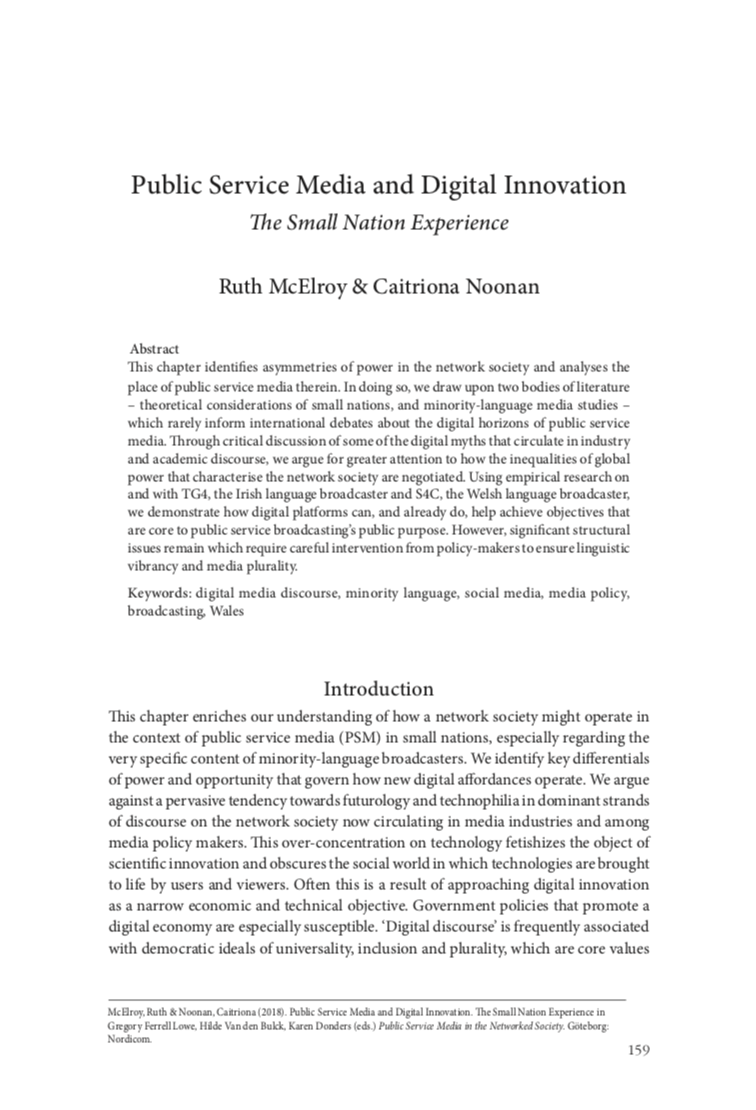
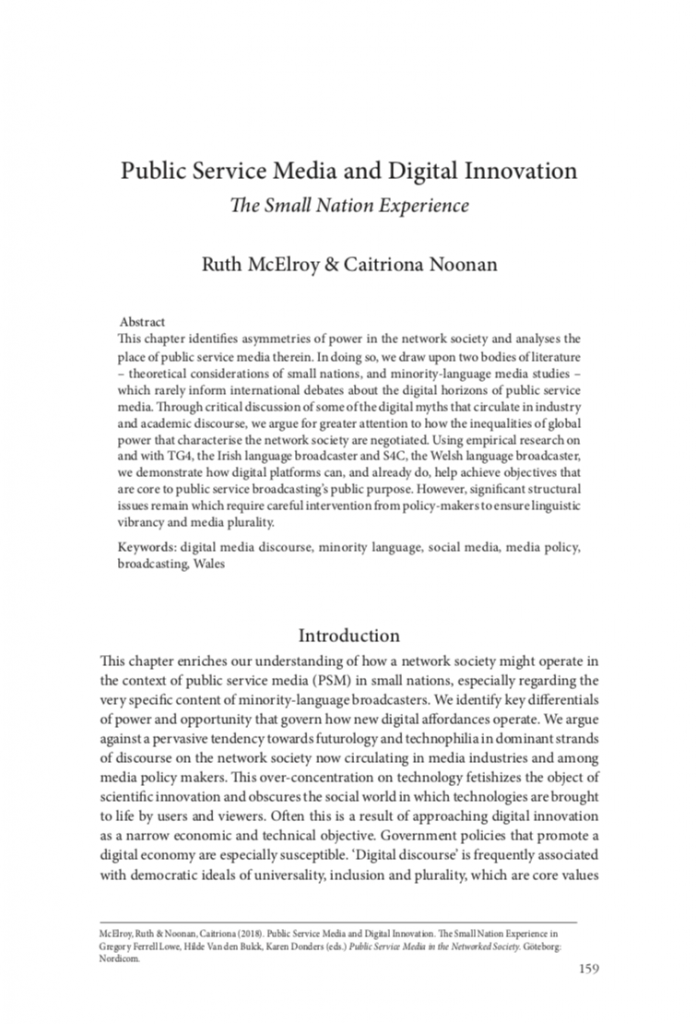
Public Service Media & Digital Innovation: The Small Nation Experience
Ruth McElroy & Caitriona Noonan
This chapter from Nordicom’s 2018 publication Public Service Media in the Networked Society, emphasises the role of public media in providing minority language services in small nation states.
This excellent paper explores the way Irish Language Broadcaster,TG4, and Welsh language broadcaster, S4C, use digital platforms to achieve objectives that are core to their public service mandate, while negotiating the “asymmetry of power in the network society”. They note that significant structural issues remain, which require the intervention of policy-makers to ensure “linguistic vibrancy and media plurality”.
Journalism, 'Fake News' and Disinformation: A Handbook for Journalism Education and Training
REPORT
Journalism, ‘Fake News’ and Disinformation: A Handbook for Journalism Education and Training (UNESCO)
This recent publication explores the key feature of journalism and seeks to guide readers on how to best navigate the news environment and fight against misinformation.
As journalism is constantly transformed and challenged by a wide range of factors, such as technology, politics and users interaction with the media, understanding how journalism works it’s becoming essential.
Written by experts from all around the world and published by UNESCO, this handbook includes modules on trust, critical thinking and social platforms, media literacy, fact checking and combating online abuse.
Given its structure, this handbook is particularly useful for journalism educators as well as media professionals and editors and all those interested in how information is shared and used.

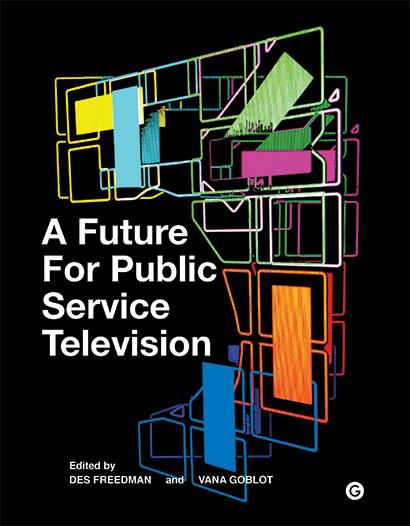
A Future for Public Service Television
Book
A Future for Public Service Television
Edited by Des Freedman and Vana Galdot
Television is on the verge of both decline and rebirth. Vast technological change has brought about financial uncertainty as well as new creative possibilities for producers, distributors and viewers. This volume examines not only the unexpected resilience of TV as cultural pastime and aesthetic practice but also the prospects for public service television in a digital, multichannel ecology.
The proliferation of platforms from Amazon and Netflix to YouTube and the vlogosphere means intense competition for audiences traditionally dominated by legacy broadcasters. Public service broadcasters – whether the BBC, the German ARD, or the Canadian Broadcasting Corporation – are particularly vulnerable to this volatility. Born in the more stable political and cultural conditions of the twentieth century, they face a range of pressures on their revenue, their remits and indeed their very futures. This book reflects on the issues raised in Lord Puttnam’s 2016 Public Service TV Inquiry Report, with contributions from leading broadcasters, academics and regulators. With resonance for students, professionals and consumers with a stake in British media, it serves both as historical record and as a look at the future of television in an on-demand age.
Contributors include
Tess Alps, Patrick Barwise, James Bennett, Georgina Born, Natasha Cox, Gunn Enli, Des Freedman, Vana Goblot, David Hendy, Jennifer Holt, Amanda D. Lotz, Sarita Malik, Matthew Powers, Lord Puttnam, Trine Syvertsen, Jon Thoday, Mark Thompson
About the Editors
Des Freedman is Professor of Media and Communications at Goldsmiths, University of London. He is project lead for the Inquiry into the Future of Public Service Television.
Vana Goblot teaches media and communications at Goldsmiths, University of London and is a research associate on the Inquiry. Her PhD examined questions of quality, cultural value and archival processes in relation to BBC4.
What we do and do not know about the impact of public service media
REPORT
What do we know about the relationship between public media and private media and their respective impacts?
The Reuters Institute for the Study of Journalism (RISJ) has published a new report commissioned by the Danish Ministry of Culture.
The report reviewed the status of public service media and private media by examining over a thousand academic and stakeholders studies. The research covered three main aspects: their political impact, social impact, and market impact.
The research indicates that there is strong evidence that public service media have a positive political impact. However, there is little research on the social and market impacts.
As RISJ says, “what we do not know about the impact of public service media, especially in a digital environment, is at least as striking as what we do know.”
Nation Binding: How Public Service Broadcasting Mitigates Political Selective Exposure
REPORT
Linda Bos, Sanne Kruikemeier, Claes de Vreese
Amsterdam School of Communication Research ASCoR, University of Amsterdam, Amsterdam, The Netherlands
(2016)
Overview
Is there a media system that promotes less political selective exposure? This article explores this question within the context of the US and Dutch media landscape, offering a comparison of the two. In particular, this article makes the case that where there is a relatively strong public service broadcaster, political selective exposure amongst an audience is lower due to its less partisan output. However, the authors do find that there is a large segment of citizens that choose to opt out of news consumption, despite its availability in today’s media landscape.
This article is Open Access, distributed under the terms of the Creative Commons Attribution License.
Moving beyond the Borders of Top–Down Broadcasting
JOURNAL
An Analysis of Younger Users’ Participation in Public Service Media
Anne-Sofie Vanhaeght and Karen Donders
Television & New Media
Vrije Universiteit Brussels, Belgium
Sage Publications
2015
Overview
This article analyses whether and to what extent public broadcasters have been able to transpose concepts like interaction, cocreation, and participation into actual media service delivery.
The article theoretically frames this discussion, first, by defining and operationalising interaction with, cocreation of, and participation in public service media (PSM), focusing mainly on participation, and, second, by analysing the challenges that emerge from these concepts.
To read the full journal article, click here.

New Zealand: Children’s Media Use Study

REPORT
“How our children engage with media today”
This research produced by New Zealand’s Broadcasting Standards Authority elucidates to the changing use of media platforms by the country’s 6-14 year olds.
The paper finds that television is still the dominant format for children although the use of tablets and smartphones is rapidly rising. It states that this age range is the biggest differentiator in media behaviour, with usage evolving as the child grows older. However, there is a clear tipping point at the age of 11 when the use of Youtube and social media rise dramatically.
The report also highlights differences between social setting, background and ethnicity in the use of different media platforms, the level of exposure and content preferences.
CRTC: Broadcasting Regulatory Policy 2015
POLICY BRIEF
“The way forward – creating compelling and diverse Canadian programming”
Published in 2015, this regulatory policy paper by the Canadian Radio-Television and Telecommunications Commission (CRTC) sets out the Commission’s findings on ways to build a future Canadian television system that encourages the creation of compelling and diverse programming made by Canadians.
The report looks to build on the current strengths of the Canadian television industry and take it into the future; ensuring its ability to develop alongside changing audience viewing habits and the growing use of on-demand services.