

Obeying His Masters’ Voices
JOURNAL
Managing Independence and Accountability in Public Service Media Between Civil Society and State
Christian S. Nissen
Chapter from: Managing Media Firms and Industries
Springer Link
(2016)
Overview
‘Obeying His Masters’ Voices: Managing Independence and Accountability in Public Service Media Between Civil Society and State’ is a chapter from Managing Media Firms and Industries, edited by Gregory Ferrell Lowe and Charles Brown.
The chapter focusses on governance issues of public media organisations, particularly the juggling act of “guarding editorial independence and securing accountability” towards the public, the stakeholders of PSM. This will be explored within the context of maintaining an independent organisation and editorial independence whilst many face growing interference from government.

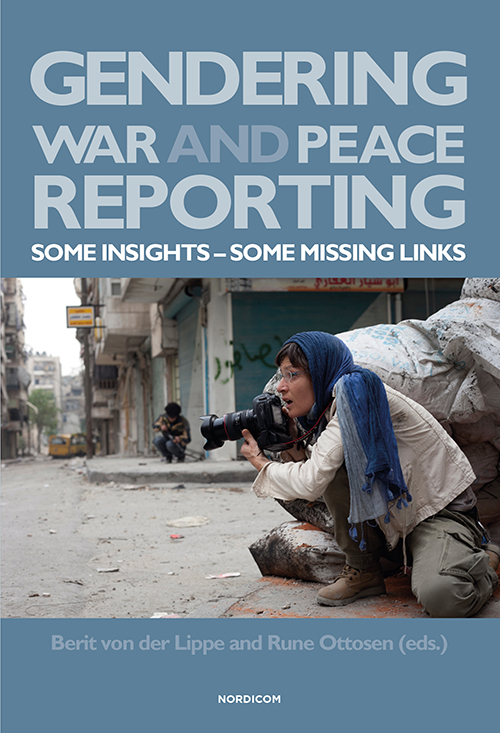
Gendering War & Peace Reporting
REPORT – BOOK
“Some Insights – Some Missing Links”
This book offers analytic approaches to how traditional war journalism is gendered. Through different case studies, the book reveals how the framing of different femininities and masculinities affects the reporting and our understanding of war and conflicts.
This fascinating and essential publication was edited by Berit von der Lippe and Rune Ottosen and contains 15 contributions from experts in the field. Key themes throughout the publication include: gendering professional agencies, women and lack of agency, postcolonial perspectives and masculinities, heroes and victims.
Published by Nordicom in December 2016.
A comparative analysis of media freedom & pluralism in the EU member states
POLICY BRIEF
Abstract
This study was commissioned by the European Parliament’s Policy Department for Citizens’ Rights and Constitutional Affairs at the request of the LIBE Committee.
The authors argue that democratic processes in several EU countries are suffering from systemic failure, with the result that the basic conditions of media pluralism are not present, and, at the same time, that the distortion in media pluralism is hampering the proper functioning of democracy. The study offers a new approach to strengthening media freedom and pluralism, bearing in mind the different political and social systems of the Member States. The authors propose concrete, enforceable and systematic actions to correct the deficiencies found.
What we do and do not know about the impact of public service media
REPORT
What do we know about the relationship between public media and private media and their respective impacts?
The Reuters Institute for the Study of Journalism (RISJ) has published a new report commissioned by the Danish Ministry of Culture.
The report reviewed the status of public service media and private media by examining over a thousand academic and stakeholders studies. The research covered three main aspects: their political impact, social impact, and market impact.
The research indicates that there is strong evidence that public service media have a positive political impact. However, there is little research on the social and market impacts.
As RISJ says, “what we do not know about the impact of public service media, especially in a digital environment, is at least as striking as what we do know.”
Making Sense of Innovation
JOURNAL
Process, product, and storytelling innovation in public service broadcasting organisations
Sandra K. Evans
Department of Communication, California State Polytechnic University, USA
(2016)
Overview
This article addresses the following question: “how do employees and managers make sense of innovation within their organizations in relation to a rapidly evolving digital media environment?”.
With a focus on public radio organisations in an increasingly digital, multi-platform media landscape, this article uses data from interviews with 56 employees from 11 public radio stations. The results, according to the author, “show how people in public media organizations make sense of innovation by relying primarily on process-oriented, rather than product-oriented frames”.
Making Public Television Social? Public Service Broadcasting and the Challenges of Social Media
JOURNAL
José van Dijck & Thomas Poell
Television & New Media
University of Amsterdam, Sage Publications
(2015)
Overview
This article investigates how the rise of social media affects European public service broadcasting (PSB), particularly in the United Kingdom and The Netherlands. The article explores this interaction on three levels: the level of the institution, professional practice, and content. The authors go on to explore how PSBs cope with the challenges of social media and whether it can be used to engage audiences without compromising public values.
Verification Handbook
Guide
This essential resource for journalists and aid providers offers the techniques, tools and step-by-step guidelines for how to deal with user-generated content (UGC) during emergencies.
Produced by the European Journalism Centre and authored by journalists from Storyful, the BBC and Digital First Media amongst others, the handbook gives “actionable advice to facilitate disaster preparedness in newsrooms, and best practices for how to verify and use information, photos and videos provided by the crowd“.
For access to this open source publication, click here.
For more access options, click here.
Public Service and Community Media
JOURNAL
Benedetta Brevini
The International Encyclopedia of Digital Communication and Society
University of Sydney. John Wiley and Sons, Inc
2015
Overview
This article outlines the similarities and differences between public service and community media. It offers a useful overview of their defining characteristics whilst situating them internationally and nationally in terms of their politics and funding mechanisms. The author goes on to explore their contemporary commercial and technological challenges.
To read the full article, click here.
CRTC: Broadcasting Regulatory Policy 2015
POLICY BRIEF
“The way forward – creating compelling and diverse Canadian programming”
Published in 2015, this regulatory policy paper by the Canadian Radio-Television and Telecommunications Commission (CRTC) sets out the Commission’s findings on ways to build a future Canadian television system that encourages the creation of compelling and diverse programming made by Canadians.
The report looks to build on the current strengths of the Canadian television industry and take it into the future; ensuring its ability to develop alongside changing audience viewing habits and the growing use of on-demand services.
Auntie Knows Best?
JOURNAL
Public broadcasters and current affairs knowledge
Stuart Soroka, Blake Andrew, Toril Aalberg, Shanto Iyengar, James Curran, Sharon Coen, Kaori Hayashi, Paul Jones, Gianpetro Mazzoleni, June Woong Rhee, David Rowe and Rod Tiffen.
Cambridge University Press, 1 January 2013, British Journal of Political Science
Abstract
“PSBs are a central part of national news media landscapes. In many countries, PSBs are the first choice of citizens when it comes to news providers. And in perhaps more countries still, PSBs are thought of as specialists in provision of hard news.
We test this proposition here using survey data from a large cross-national survey involving indicators of current affairs knowledge and media consumption. Specifically, we examine whether exposure to public versus commercial news influences the knowledge citizens possess about current affairs, both domestically and internationally. We also test, using propensity score analysis, whether there is variation across PSBs in this regard.
Results indicate that compared to commercial news, watching PSB has a net positive influence on knowledge of hard news, though not all PSBs are equally effective in contributing to knowledge acquisition. This knowledge gap between PSB and commercial news media consumption appears to be mitigated by factors such as de jure independence proportion of public financing, and audience share.”