

Shining a Spotlight on Media Freedom?
REPORT
Shining a Spotlight on Media Freedom?
Media Coverage of the Global Campaign for Media Freedom
City, University of London; University of East Anglia | Martin Scott, Mel Bunce, Mary Myers
Published: 2020
In our first project report, we analyse English-language, online news coverage and Twitter commentary about media freedom. Specifically, we ask whether the Global Campaign for Media Freedom (GCMF) has succeeded in ‘shining a spotlight’ on media freedom in its first year of activities, from July 2019- July 2020.

Funding Journalism in Israel: Secrecy and Political Influence
WEBSITE
Funding Journalism in Israel: Secrecy and Political Influence
Center for Media, Data and Society | Central European University
Published: June 2020
Unusual opacity is the most salient characteristic of the media system in Israel, where the involvement of political figures in media operation raises serious concerns.
At first glance, the Israeli media market seems a diverse mix of old and new, public and commercial, cable and satellite, and increasingly dominant, if not ubiquitous, digital media. But beneath the appearance of this growing diversity, there is little pluralism…
Text sourced from CMDS | CEU

Soft Power, Hard News: How Journalists at State-Funded Transnational Media Legitimize Their Work
JOURNAL
Soft Power, Hard News: How Journalists at State-Funded Transnational Media Legitimize Their Work
Kate Wright, Martin Scott, Mel Bunce | Sage Journals
Published: May 2020
How do journalists working for different state-funded international news organizations legitimize their relationship to the governments which support them? In what circumstances might such journalists resist the diplomatic strategies of their funding states?
We address these questions through a comparative study of journalists working for international news organizations funded by the Chinese, US, UK and Qatari governments. Using 52 interviews with journalists covering humanitarian issues, we explain how they minimized tensions between their diplomatic role and dominant norms of journalistic autonomy by drawing on three – broadly shared – legitimizing narratives, involving different kinds of boundary-work. In the first ‘exclusionary’ narrative, journalists differentiated their ‘truthful’ news reporting from the ‘false’ state ‘propaganda’ of a common Other, the Russian-funded network, RT. In the second ‘fuzzifying’ narrative, journalists deployed the ambiguous notion of ‘soft power’ as an ambivalent ‘boundary concept’, to defuse conflicts between journalistic and diplomatic agendas. In the final ‘inversion’ narrative, journalists argued that, paradoxically, their dependence on funding states gave them greater ‘operational autonomy’. Even when journalists did resist their funding states, this was hidden or partial, and prompted less by journalists’ concerns about the political effects of their work, than by serious threats to their personal cultural capital.
Small Screen: Big Debate
WEBSITE
Small Screen: Big Debate
Ofcom
2020
Join the conversation on the future of public service broadcasting in the UK
This website will allow you to access a wide variety of research, learn more of our work in this area and submit your views directly to us on the future of public service broadcasting and media.
Reporting facts: free from fear or favour
REPORT
Reporting Facts: Free from fear or favour
UNESCO | Marius Dragomir
Published: 2020
Preview of In Focus report on World Trends in Freedom of Expression and Media Development
Countering Disinformation
WEBSITE
Countering Disinformation
Cardiff University | Arts and Humanities Research Council
2020
“Disinformation is a growing risk to the health of many democratic systems. Funded by the Arts and Humanities Research Council, this project will assess how leading UK public service media are counteracting it in news reporting.”
This project is the largest of its kind in the UK and focusses on the content produced by The BBC, Channel 4 ITV and Sky News. It aims to provide a “comprehensive understanding of how British public service media and audiences are developing practices to address and counter disinformation. “
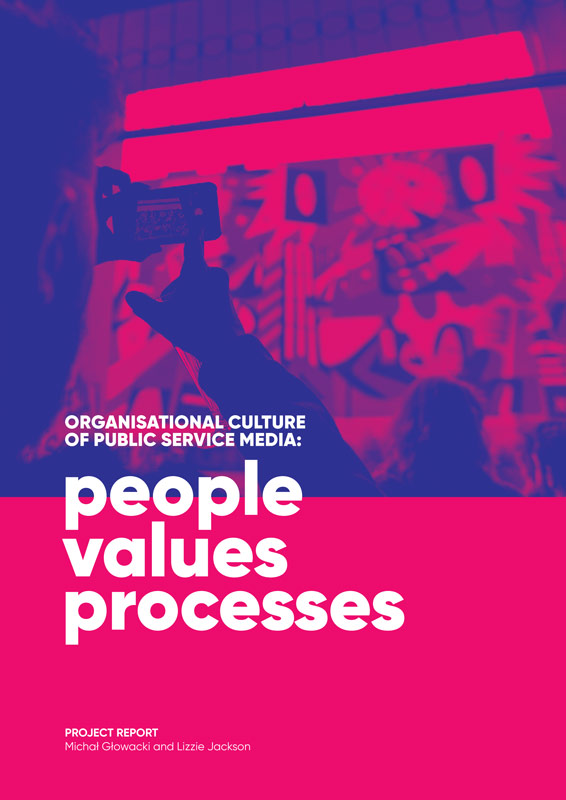
Organisational Culture of Public Service Media: People, values, processes
REPORT
Organisational Culture of Public Service Media: People, values, processes
Dr Michał Głowacki and Professor Lizzie Jackson
2019
In 2015-2019 Dr Michał Głowacki and Professor Lizzie Jackson investigated the internal organisational cultures of ten successful high technology clusters in North America and Europe to identify strategies to support the evolution of Public Service Media worldwide.
Four media clusters were located in North America: Austin (Texas), Boston/Cambridge (Massachusetts), Detroit (Michigan) and Toronto (Canada). European clusters included London (UK), Warsaw (Poland), Copenhagen (Denmark), Brussels (Belgium), Tallinn (Estonia), and Vienna (Austria). To answer the question ‘what people, values and processes’ should Public Service Media embody going forward we found there is an urgent need for adaptation. Without internal change there is likely to be a decline in the ability of PSM to survive within the fast-evolving contemporary media and communications production and distribution landscape.
Universalism in Public Service Media
Book
Universalism in Public Service Media
RIPE@2019
Edited by Philip Savage, Mercedes Medina, Gregory Ferrell Lowe
Published by Nordicom
Since the start of telephony and later in broadcasting, the pursuit of universal service has legitimated the ownership and operation of media as a public trust.
Until the 1980s, this principle was the bedrock for the broadcasting mission and is still a mandated requirement for public media companies today. But in practice, the universalism ideal was largely abandoned in the 1980s as media deregulation promised more competition, innovation, and vigorous economic growth. Some of this came true, but at a worrisome cost. Growing distrust in media today is partly rooted in the illusion that more media in more platforms would inevitably ensure better media in all platforms. There is now more of everything on offer except social responsibility. This collection interrogates the historic universalism mission in public service broadcasting and explores its contemporary relevance for public service media. Taking a critical perspective on media policy and performance, the volume contributes to a much-needed contemporary reassessment that clarifies the importance of universalism for equity in access and provision, trustworthy content, and inclusive participation in the context of advancing digitalisation and globalisation. The collection situates universalism as an aspirational quest and inspirational pursuit. Researchers and policy makers will find the collection valuable for conceptualisation and strategic managers will find it helpful as a principled basis in the pursuit of improved reach and value.
(Text sourced via RIPE & Nordicom)
The Value of PSM
REPORT
The Value of PSM
This European Broadcast Union publication from January 2020 showcases the value that public service media brings to European citizens.
The content is available on the EBU website, via login.
The Journalism AI
REPORT
The Journalism AI
Charlie Beckett
Abstract
The Journalism AI report is based on a survey of 71 news organisations in 32 different countries regarding artificial intelligence and associated technologies. A wide range of journalists working with AI answered questions about their understanding of AI, how it was used in their newsrooms, and their views on the wider potential and risks for the news industry.