

RISJ Digital News Report 2018
REPORT
RISJ Digital News Report 2018
This year’s edition of the ever comprehensive Reuters Institute Digital News Report highlights a fall in the use of social media for news in a number of key markets
The extensive report is based on an online survey of 74,000 people from 37 countries, across five continents, and explores issues such as trust in the media, disinformation, viewing trends, podcasting and ad-blockers to name but a few. It also includes new literacy and brand trust for the first time.
A major finding in this year’s report is that the use of social media for news has significantly declined in France, the UK and the USA – the latter being down six percent. According to a summary by report author Nic Newman, the decline is due to a decrease in the discovery, posting, and sharing of news in Facebook. However, there has been a significant rise in the use of private messaging apps as a means to communicate, share and discuss news stories.
Other findings include a relatively stable average level of trust in news, with 44% of respondents claiming they trust it overall. This declines to 34% if referring specifically to news found via a search engine and 23% if found via social media.
With regards to fake news, the survey found that just over half of respondents are concerned about fake news, with the highest percentages found in countries with the “most polarised political situations”. 75% of respondents also believe that responsibility to fix unreliable news lies with publishers, while 71% believe the same for platforms, with some appetite for government intervention.
Find out more about this in-depth report by following the link below.

Humanitarian Journalism
WEBSITE
Text from Humanitarian Journalism:
The Humanitarian Journalism project is seeking to better understand how the news media report on humanitarian crises and what shapes their coverage.
We are seeking to map the sub-field of humanitarian journalism and in doing so, further investigate:
1) How journalists define humanitarian news
2) How such news is shaped by political, economic and technological factors
3) What the impact of humanitarian news is on the humanitarian sector
This project is an interdisciplinary, multi-institutional collaboration that draws on newsroom ethnography, interviews and content analysis. Please get in touch if you have any questions about our work. Further details about the research team, our outputs, publications and partners can be found on this site.
The project is primarily a collaboration between Dr Mel Bunce (City, University of London), Dr Martin Scott (University of East Anglia) and Dr Kate Wright (Edinburgh University). Click on the link below to find out more and access resources.
The Public Media Alliance is an institutional partner of Humanitarian Journalism.
Featured Image: The NORAD of ABC in Austin. Image: Trey Ratcliff/Creative Commons
PSM research websites
WEBSITE
Are you interested in public service media (PSM) research? Are you struggling to find specific research articles related to contemporary PSM around the world?
Here you will find a number of recommended organisations that specialise in PSM and other relevant media research. Their websites play host to a wealth of publications, event listings and PSM research news.
Where possible we will link to organisations that make their research publicly available.
Remember to explore PMA’s Knowledge Hub for our recent publications, recommended articles and research news from around the world.
Deutsche Welle Akademie
DW Akademie is Germany’s leading organization for international media development. It supports the development of free and transparent media, quality journalism, and also offers programmes to boost media skills.
The Akademie offers a range of training opportunities for journalists and media organisations as well as clients from politics, business and civil society. Its Master’s degree program , “International Media Studies”, combines the disciplines of media and development, journalism, communication studies and media management.
Beyond media training, DW Akademie runs a variety of media development projects and research programmes around the world, with further efforts to promote media freedom and freedom of expression.
Its website hosts a number of articles and reports relevant to public media, such as In Service of the Public. You can find a wealth of other media development articles and publications here.
For more information, click here.
ECPMF & OBCT Resource Centre
An open and growing resource website developed by Osservatorio Balcani e Caucaso Transeuropa (OBCT) and the European Centre for Press and Media Freedom (ECPMF).
The site has a broad range of resources ranging from academic papers to legal tools and practical instruments for training purposes. The resources are curated with a focus on Europe and issues surrounding democracy and particularly media freedom in the region.
Despite being launched in 2015 there are already over one thousand resource items available.
For more information, click here.
Global PSM Experts Network/PMR
The Global PSM Experts Network is a joint project of the EBU and the RIPE network which operates as a platform for bringing together researchers and experts of public service media around the world.
‘This Network will merge with the International Association of Public Media Researchers (PMR). PMR will be an association for scholars and industry experts who support Public Media worldwide. It’s a continuation of the RIPE network and, just like RIPE, will feature an online community, a bi-annual conference jointly hosted by a university and their local public service media, and a biannual edited collection of the most world-leading scholarly work for the year of publication.
The activities include:
– Bi-annual conferences
– Related open-access Readers by Nordicom
– Discussions and information exchanges in our social media communities on Facebook and Twitter
For more information, click here to access the network’s Facebook group whilst they launch their new website.
InnoPSM
Innovation in Public Service Media Policies (InnoPSM) is a new ARHC-funded research network, which uses a multi-stakeholder approach to bring together academic experts, practitioners and policymakers with a shared interest in PSM to discuss global, ‘innovative policy solutions and strategies’ to confront the contemporary challenges facing PSM in the digital age.
Read PMA’s report on InnoPSM’s launch and activities here.
NHK Broadcasting Culture Research Institute
Founded in 1946, The NHK Broadcasting Culture Research Institute was the “first facility for comprehensive research to be operated by a broadcasting station”.
Operated by Japanese PSB NHK, the institute conducts research into various media and social fields to deepen and enrich the quality of broadcasting culture in Japan, the Pacific region and worldwide. Its website hosts an extensive catalogue of open-source research reports and publications, with many available in English. According to the institute;
“The findings, which are made public, not only contribute to better NHK programming and program production, but also modify the basic framework of public broadcasting. The Institute suggests how broadcasting might change in the digital era and analyzes new broadcasting services.
The Institute surveys public opinion to generate data that can be used when preparing programs and publications, as well as in other planning activities. The Institute also conducts research on survey methods and data analysis.”
For more information, click here.
Nordicom
NORDICOM is a knowledge centre in the field of media and communication research – a cooperation between Denmark, Finland, Iceland, Norway and Sweden.
Research at Nordicom is focussed on three core working areas: Media and Communication Research Findings in the Nordic Countries, Trends and Developments in the Media Sectors in the Nordic Countries and Research on Young People and Media Worldwide.
Their website plays host to a variety of open source and paid-for research publications and journal papers, with frequent calls for papers. According to Nordicom they specialise in the following:
“Starting from academic research, Nordicom collects and adapts knowledge, mediating it to various user groups in the Nordic region, Europe and elsewhere in the world. Nordicom is an institution under the auspices of the Nordic Council of Ministers.
Nordicom’s work aims at developing media studies and at helping to ensure that research results are made visible in the treatment of media issues at different levels in both the public and private sector. Nordicom’s activities are based on broad and extensive network of contacts and collaboration with members of the research community, media companies, politicians, regulators, teachers, librarians, and so forth, around the world.”
To find out more click here.
RIPE
The initiative for Re-Visionary Interpretations of the Public Enterprise (RIPE) is a non-profit international network of scholars and practitioners involved with the study, development and management of public service media organisations.
RIPE is an international project that is dedicated to reinventing, redefining, and recreating the meanings and practices of public service in media for the 21st century. Although many of the original conceptualisations of public media have continuing relevance today – despite rapid and sweeping changes – it is crystal clear that conditions, needs and situations are much different and more varied today when compared with the realities that legitimated the heritage approach that was developed in the early to mid-20th century in Western Europe.
RIPE has an astounding source of globally sourced and open articles on its website and hosts a biennial conference that brings together research contributors, PSM specialists and other contributors to discuss the current and future PSM landscape worldwide.
To find out more and access RIPE’s extensive research archives, click here.

Policy Websites
WEBSITE
This space is dedicated to recommended public media policy websites.
We will update this page when possible. Please get in touch if you have any recommendations.
EC Media Freedom and Pluralism
Acts, articles, policies and studies into media freedom and pluralism by the European Commission as part of their ‘Digital Agenda for Europe’.
“The importance of transparency, freedom and diversity in Europe’s media landscape. The European Commission commits to respect freedom and pluralism of media. In this page you can find several acts, documents and studies on the subject.”
Fesmedia Africa
A diverse and independent broadcasting sector, supplying information and other programming of public interest, is essential to a functioning democracy. Fesmedia Africa promotes efforts to create a policy, legal and regulatory framework for an independent broadcasting sector which is based on the African Charter on Broadcasting (UNESCO)and The Declaration of Principles on Freedom of Expression in Africa.
“Fesmedia Africa supports public participation in the formulation of broadcasting policy and regulation, as well as in the management and content development of public service and community broadcasters. We work with local partners and civil society coalitions, parliamentarians and governments (where they are willing) towards the realization of an independent, strong and competitive public broadcaster and promote diverse public interest broadcasting content.
Our focus in all our activities in the broadcasting sector is the “public”, be it in the transformation of a state into a truly public service broadcaster, through the support of community broadcasters and developing their “public” programming or by supporting “public” formats for private broadcasters.”
Media Monitoring Africa
MMA aims to promote the development of a free, fair, ethical and critical media culture in South Africa and the rest of the continent.
“Media Monitoring Africa (formerly Media Monitoring Project) is a non-profit organisation that promotes democracy and a culture where media and the powerful respect human rights and encourage a just and fair society. MMA acts in a watchdog role to promote ethical and fair journalism that supports human rights.”
Media Policy Project Blog
A great resource blog from the London School of Economics with a section dedicated to public service broadcasting, particularly that in the UK.
“The Media Policy Project’s goal is to start conversations between policy makers, civil society actors, and media professionals about the latest media research. We want policy makers to have timely, easy access to relevant research and to the range of views held by civil society. We also work to engage the policy community with research on the policy making process itself. Additionally, we provide tools for anyone looking to stay up-to-date on media policy issues, though our briefings, event calendars, dossiers, and lists of on-going consultations.”
Trust in Ethical Journalism – The Key to Media Futures
REPORT
EJN Report: Trust in Ethical Journalism – The Key to Media Futures
Ethical Journalism Network Press Release
If 2017 was the year the world finally woke up to the threat of disinformation and the way internet technologies are secretly and subtly used to undermine democracy, then 2018 is becoming the year when ethical journalism, a human instinct beyond encoding and algorithmic definition, finally gets the recognition it deserves.
 This issue of Ethics in the News looks at how the communications revolution is continuing to pose more questions than answers over a public crisis of confidence, both in democracy and in sources of public information.
How do we build trust in journalism and news media? Must we sacrifice human rights and pluralism in return for free digital services? How do we stem the flow of hate speech, propaganda and malicious lies without endangering free speech? How do we pay for the journalism that democracy needs to survive?
Around the world these debates rage, but in some countries and regions, the arguments are anything but theoretical. The rise of populism accompanied by a discreet use of technology to target voters or promote hate speech is tearing into the fabric of democracy everywhere. In countries wracked by economic and social crisis or in the aftermath of war, these threats are a major obstacle to peace and development.
In this issue we examine the technological, political and social realities of the information crisis: how algorithms and artificial intelligence are setting a new and potentially troubling agenda; how advertising platforms and the business of social media are undermining public trust; how democracy and political elections are open to undue interference.
But it is not all bad news. From the Middle East and the Balkans there are inspiring stories of journalists and media working together, even across political divides, to develop new initiatives to challenge the hate-mongers. In Turkey a new spirit of media solidarity is in the air. In Africa there are new approaches to reporting terrorism and conflict and a fresh debate about the protection of authors’ rights in the digital age.
Everywhere ethical issues abound – improving the role and portrayal of women in media; combating discrimination and intolerance; improving coverage of migration and human trafficking; and, importantly for all journalists and media, building a sustainable future for journalism without surrendering the cardinal principle of editorial freedom and independence.
The messages are mixed, but they point in one direction, towards a communications landscape that people can trust. It won’t happen overnight, but such a vision will not be realised at all unless strategies for the future embrace public interest journalism, good governance in media, and a public information system rooted in ethics and transparency.
The Ethical Journalism Network is a partner of the Public Media Alliance.
A Future for Public Service Television
Book
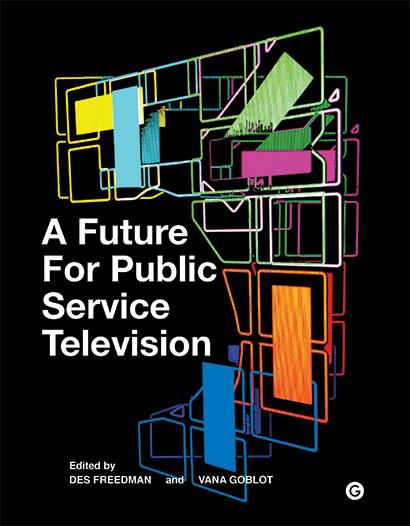
A Future for Public Service Television
Edited by Des Freedman and Vana Galdot
Television is on the verge of both decline and rebirth. Vast technological change has brought about financial uncertainty as well as new creative possibilities for producers, distributors and viewers. This volume examines not only the unexpected resilience of TV as cultural pastime and aesthetic practice but also the prospects for public service television in a digital, multichannel ecology.
The proliferation of platforms from Amazon and Netflix to YouTube and the vlogosphere means intense competition for audiences traditionally dominated by legacy broadcasters. Public service broadcasters – whether the BBC, the German ARD, or the Canadian Broadcasting Corporation – are particularly vulnerable to this volatility. Born in the more stable political and cultural conditions of the twentieth century, they face a range of pressures on their revenue, their remits and indeed their very futures. This book reflects on the issues raised in Lord Puttnam’s 2016 Public Service TV Inquiry Report, with contributions from leading broadcasters, academics and regulators. With resonance for students, professionals and consumers with a stake in British media, it serves both as historical record and as a look at the future of television in an on-demand age.
Contributors include
Tess Alps, Patrick Barwise, James Bennett, Georgina Born, Natasha Cox, Gunn Enli, Des Freedman, Vana Goblot, David Hendy, Jennifer Holt, Amanda D. Lotz, Sarita Malik, Matthew Powers, Lord Puttnam, Trine Syvertsen, Jon Thoday, Mark Thompson
About the Editors
Des Freedman is Professor of Media and Communications at Goldsmiths, University of London. He is project lead for the Inquiry into the Future of Public Service Television.
Vana Goblot teaches media and communications at Goldsmiths, University of London and is a research associate on the Inquiry. Her PhD examined questions of quality, cultural value and archival processes in relation to BBC4.
Hate speech: What it is and how to contrast it?
Dossier
This special dossier compiled by Osservatorio Balcani Caucaso Transeuropa is the third in in a series of thematic publications exploring hate speech and its implications for media freedom in Europe.
This report reflects on the commonly used term and pinpoint its definition as it clashes within juridical, political-philosophical, and cultural debates over the boundaries of freedom of expression. In doing so it explores its changing terminology over time and potential ways of combating the issue within the context of the "post-truth era", rapid technological change and the rise of populism in recent years.
This publication has been produced within the project European Centre for Press and Media Freedom, co-funded by the European Commission.
Thumbnail Image: ECPMF/OBC Transeuropa
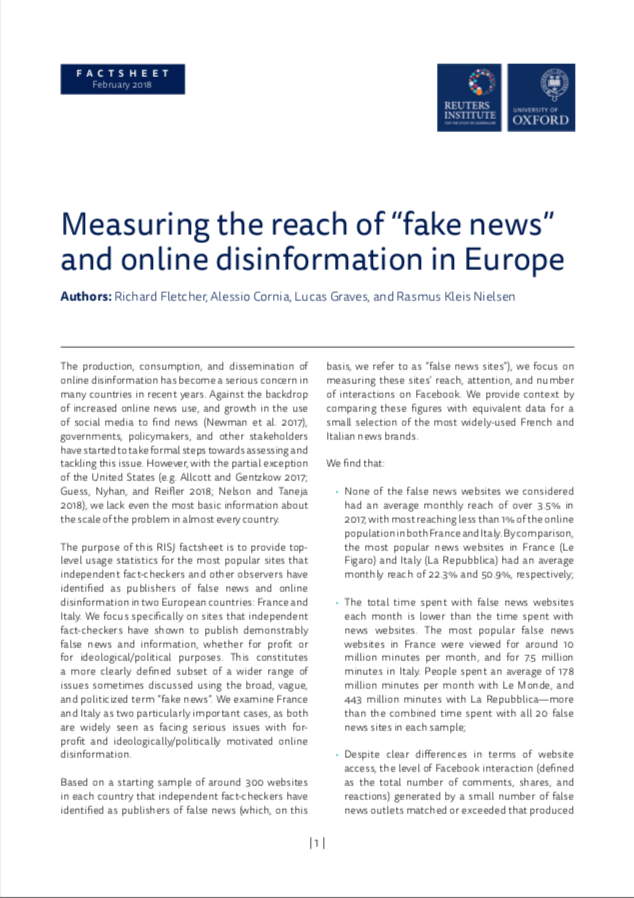
Measuring the reach of "fake news" and online disinformation in Europe.
JOURNAL
Comprehensive factsheet by the team at the Reuters Institute for the Study of Journalism (RISJ) highlighting top-level usage statistics for the most popular sites that independent fact-checkers and other observers have identified as publishers of false news and online disinformation.
The factsheet was compiled by Richard Fletcher, Alessio Cornia, Lucas Graves and Rasmus Kleis Nielsen. The report focuses on Italy and France as both are widely seen as facing particular pressure from for-profit and ideologically/politically motivated online disinformation.
Follow the link below for the full report.
Thumbnail Image: RISJ
Public service media, universality and personalisation through algorithms: Mapping strategies and exploring dilemmas
JOURNAL
Hilde Van den Bulck, Hallvard Moe
(2017)
This contribution compares personalisation strategies of public service media (PSM) and how these are reconciled with PSM’s core values, especially universality. To this end, it combines mapping of a sample of PSM with in-depth analysis of Flemish VRT and Norwegian NRK.
Find out more and access the full text via the Sage Journal website. University/Institutional login may be required.
[Text sourced from Sage Journals]
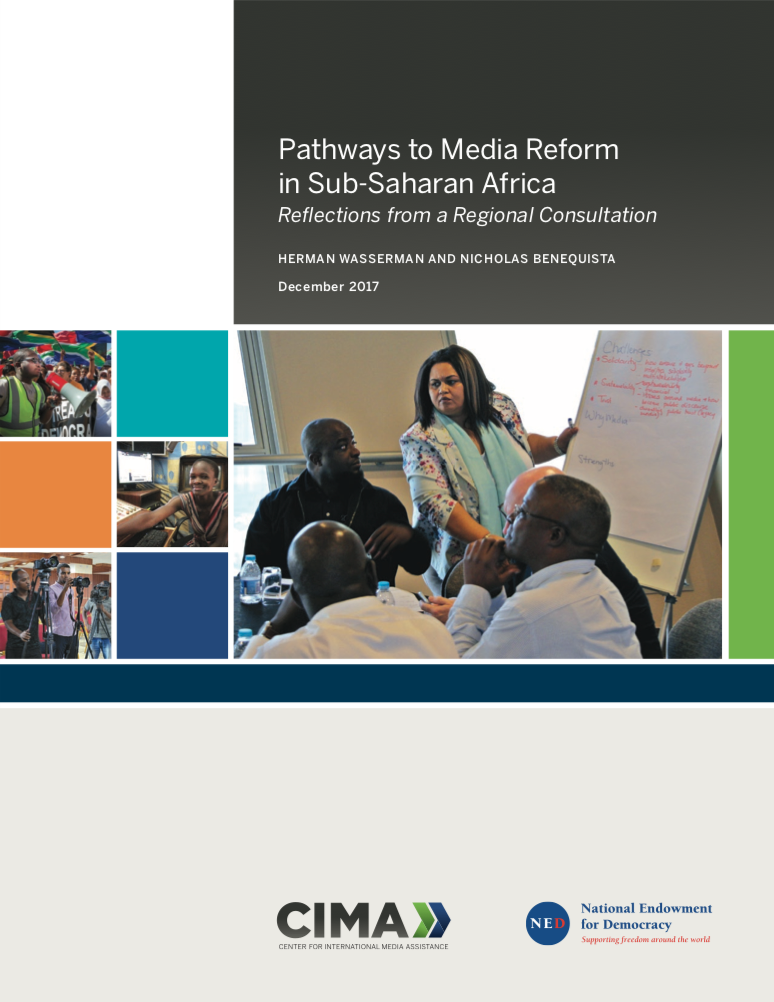
Pathways to Media Reform in Sub‑Saharan Africa: Reflections from a Regional Consultation
REPORT
This report lays out a vision for how the continuing struggle for vibrant, independent, and plural media systems in the region might more effectively bolster efforts of democratic revitalization.
The report draws on the input of 36 experts in media and governance from 15 countries in sub-Saharan Africa who met in Durban, South Africa, in July 2017, and it deepens the insights and ideas that came from this group by documenting previously successful media reforms in sub-Saharan Africa.
[Text sourced from CIMA]
Thumbnail Image: CIMA