

Media Influence Matrix
REPORT
Media Influence Matrix Project
Central European University’s Centre for Media, Data and Society (CEU-CMDS)
About
Launched in 2017, the CMDS project maps and assesses “the state of journalism on a country-by-country basis”. Country reports include articles, analytical papers and data sets that aim to answer questions on regulation, funding and technology.

Future and Emerging Technologies for the Media Sector
REPORT
Future and Emerging Technologies for the Media Sector
MediaRoad
Abstract
The second Vision Paper by MediaRoad’s Policy Hub analyses the potential impact of six technological trends (Artificial Intelligence (AI), Immersive technologies, Blockchain, 5G, Internet of Things (IoT) and Convergence) on the media sector together with their political, social and economic consequences.
Based on the analysis, the paper puts forward policy recommendations with the aim of supporting a positive impact of these technologies on European society. The technological trends considered are at different stages of development and, as a consequence, some of them have already consistent European policy and legal frameworks established and running; others are at a less mature stage of development and societal appropriation.
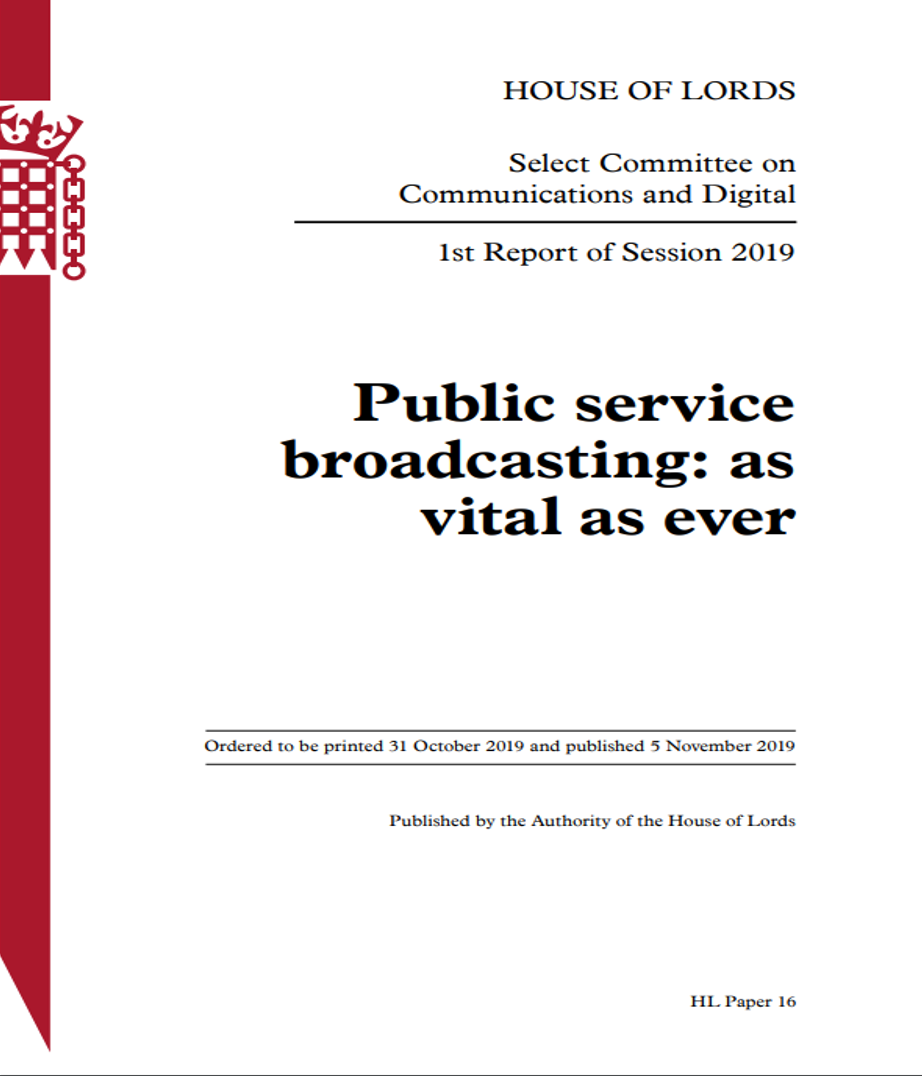
Public service broadcasting: as vital as ever
REPORT
Public service broadcasting: as vital as ever
By The UK House of Lords Select Committee on Communications

The House of Lords report on public service broadcasting in the age of video on demand concludes that PSBs are vital and in need of better support to produce high quality content and programming. But they also need to adapt to the changing media landscape in order to better serve audiences.
The report also reveals that public service broadcasting remains prominent within the UK and is a driver of the creative economy. Recommendations include the establishment of a new body called the BBC Funding Commission and to ensure that deals and plans are conducted with more transparency.
Read the PMA response to this report here.

PSM research websites
WEBSITE
Are you interested in public service media (PSM) research? Are you struggling to find specific research articles related to contemporary PSM around the world?
Here you will find a number of recommended organisations that specialise in PSM and other relevant media research. Their websites play host to a wealth of publications, event listings and PSM research news.
Where possible we will link to organisations that make their research publicly available.
Remember to explore PMA’s Knowledge Hub for our recent publications, recommended articles and research news from around the world.
Deutsche Welle Akademie
DW Akademie is Germany’s leading organization for international media development. It supports the development of free and transparent media, quality journalism, and also offers programmes to boost media skills.
The Akademie offers a range of training opportunities for journalists and media organisations as well as clients from politics, business and civil society. Its Master’s degree program , “International Media Studies”, combines the disciplines of media and development, journalism, communication studies and media management.
Beyond media training, DW Akademie runs a variety of media development projects and research programmes around the world, with further efforts to promote media freedom and freedom of expression.
Its website hosts a number of articles and reports relevant to public media, such as In Service of the Public. You can find a wealth of other media development articles and publications here.
For more information, click here.
ECPMF & OBCT Resource Centre
An open and growing resource website developed by Osservatorio Balcani e Caucaso Transeuropa (OBCT) and the European Centre for Press and Media Freedom (ECPMF).
The site has a broad range of resources ranging from academic papers to legal tools and practical instruments for training purposes. The resources are curated with a focus on Europe and issues surrounding democracy and particularly media freedom in the region.
Despite being launched in 2015 there are already over one thousand resource items available.
For more information, click here.
Global PSM Experts Network/PMR
The Global PSM Experts Network is a joint project of the EBU and the RIPE network which operates as a platform for bringing together researchers and experts of public service media around the world.
‘This Network will merge with the International Association of Public Media Researchers (PMR). PMR will be an association for scholars and industry experts who support Public Media worldwide. It’s a continuation of the RIPE network and, just like RIPE, will feature an online community, a bi-annual conference jointly hosted by a university and their local public service media, and a biannual edited collection of the most world-leading scholarly work for the year of publication.
The activities include:
– Bi-annual conferences
– Related open-access Readers by Nordicom
– Discussions and information exchanges in our social media communities on Facebook and Twitter
For more information, click here to access the network’s Facebook group whilst they launch their new website.
InnoPSM
Innovation in Public Service Media Policies (InnoPSM) is a new ARHC-funded research network, which uses a multi-stakeholder approach to bring together academic experts, practitioners and policymakers with a shared interest in PSM to discuss global, ‘innovative policy solutions and strategies’ to confront the contemporary challenges facing PSM in the digital age.
Read PMA’s report on InnoPSM’s launch and activities here.
NHK Broadcasting Culture Research Institute
Founded in 1946, The NHK Broadcasting Culture Research Institute was the “first facility for comprehensive research to be operated by a broadcasting station”.
Operated by Japanese PSB NHK, the institute conducts research into various media and social fields to deepen and enrich the quality of broadcasting culture in Japan, the Pacific region and worldwide. Its website hosts an extensive catalogue of open-source research reports and publications, with many available in English. According to the institute;
“The findings, which are made public, not only contribute to better NHK programming and program production, but also modify the basic framework of public broadcasting. The Institute suggests how broadcasting might change in the digital era and analyzes new broadcasting services.
The Institute surveys public opinion to generate data that can be used when preparing programs and publications, as well as in other planning activities. The Institute also conducts research on survey methods and data analysis.”
For more information, click here.
Nordicom
NORDICOM is a knowledge centre in the field of media and communication research – a cooperation between Denmark, Finland, Iceland, Norway and Sweden.
Research at Nordicom is focussed on three core working areas: Media and Communication Research Findings in the Nordic Countries, Trends and Developments in the Media Sectors in the Nordic Countries and Research on Young People and Media Worldwide.
Their website plays host to a variety of open source and paid-for research publications and journal papers, with frequent calls for papers. According to Nordicom they specialise in the following:
“Starting from academic research, Nordicom collects and adapts knowledge, mediating it to various user groups in the Nordic region, Europe and elsewhere in the world. Nordicom is an institution under the auspices of the Nordic Council of Ministers.
Nordicom’s work aims at developing media studies and at helping to ensure that research results are made visible in the treatment of media issues at different levels in both the public and private sector. Nordicom’s activities are based on broad and extensive network of contacts and collaboration with members of the research community, media companies, politicians, regulators, teachers, librarians, and so forth, around the world.”
To find out more click here.
RIPE
The initiative for Re-Visionary Interpretations of the Public Enterprise (RIPE) is a non-profit international network of scholars and practitioners involved with the study, development and management of public service media organisations.
RIPE is an international project that is dedicated to reinventing, redefining, and recreating the meanings and practices of public service in media for the 21st century. Although many of the original conceptualisations of public media have continuing relevance today – despite rapid and sweeping changes – it is crystal clear that conditions, needs and situations are much different and more varied today when compared with the realities that legitimated the heritage approach that was developed in the early to mid-20th century in Western Europe.
RIPE has an astounding source of globally sourced and open articles on its website and hosts a biennial conference that brings together research contributors, PSM specialists and other contributors to discuss the current and future PSM landscape worldwide.
To find out more and access RIPE’s extensive research archives, click here.

Policy Websites
WEBSITE
This space is dedicated to recommended public media policy websites.
We will update this page when possible. Please get in touch if you have any recommendations.
EC Media Freedom and Pluralism
Acts, articles, policies and studies into media freedom and pluralism by the European Commission as part of their ‘Digital Agenda for Europe’.
“The importance of transparency, freedom and diversity in Europe’s media landscape. The European Commission commits to respect freedom and pluralism of media. In this page you can find several acts, documents and studies on the subject.”
Fesmedia Africa
A diverse and independent broadcasting sector, supplying information and other programming of public interest, is essential to a functioning democracy. Fesmedia Africa promotes efforts to create a policy, legal and regulatory framework for an independent broadcasting sector which is based on the African Charter on Broadcasting (UNESCO)and The Declaration of Principles on Freedom of Expression in Africa.
“Fesmedia Africa supports public participation in the formulation of broadcasting policy and regulation, as well as in the management and content development of public service and community broadcasters. We work with local partners and civil society coalitions, parliamentarians and governments (where they are willing) towards the realization of an independent, strong and competitive public broadcaster and promote diverse public interest broadcasting content.
Our focus in all our activities in the broadcasting sector is the “public”, be it in the transformation of a state into a truly public service broadcaster, through the support of community broadcasters and developing their “public” programming or by supporting “public” formats for private broadcasters.”
Media Monitoring Africa
MMA aims to promote the development of a free, fair, ethical and critical media culture in South Africa and the rest of the continent.
“Media Monitoring Africa (formerly Media Monitoring Project) is a non-profit organisation that promotes democracy and a culture where media and the powerful respect human rights and encourage a just and fair society. MMA acts in a watchdog role to promote ethical and fair journalism that supports human rights.”
Media Policy Project Blog
A great resource blog from the London School of Economics with a section dedicated to public service broadcasting, particularly that in the UK.
“The Media Policy Project’s goal is to start conversations between policy makers, civil society actors, and media professionals about the latest media research. We want policy makers to have timely, easy access to relevant research and to the range of views held by civil society. We also work to engage the policy community with research on the policy making process itself. Additionally, we provide tools for anyone looking to stay up-to-date on media policy issues, though our briefings, event calendars, dossiers, and lists of on-going consultations.”
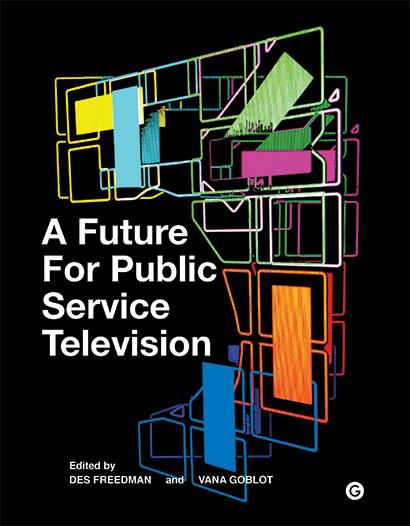
A Future for Public Service Television
Book
A Future for Public Service Television
Edited by Des Freedman and Vana Galdot
Television is on the verge of both decline and rebirth. Vast technological change has brought about financial uncertainty as well as new creative possibilities for producers, distributors and viewers. This volume examines not only the unexpected resilience of TV as cultural pastime and aesthetic practice but also the prospects for public service television in a digital, multichannel ecology.
The proliferation of platforms from Amazon and Netflix to YouTube and the vlogosphere means intense competition for audiences traditionally dominated by legacy broadcasters. Public service broadcasters – whether the BBC, the German ARD, or the Canadian Broadcasting Corporation – are particularly vulnerable to this volatility. Born in the more stable political and cultural conditions of the twentieth century, they face a range of pressures on their revenue, their remits and indeed their very futures. This book reflects on the issues raised in Lord Puttnam’s 2016 Public Service TV Inquiry Report, with contributions from leading broadcasters, academics and regulators. With resonance for students, professionals and consumers with a stake in British media, it serves both as historical record and as a look at the future of television in an on-demand age.
Contributors include
Tess Alps, Patrick Barwise, James Bennett, Georgina Born, Natasha Cox, Gunn Enli, Des Freedman, Vana Goblot, David Hendy, Jennifer Holt, Amanda D. Lotz, Sarita Malik, Matthew Powers, Lord Puttnam, Trine Syvertsen, Jon Thoday, Mark Thompson
About the Editors
Des Freedman is Professor of Media and Communications at Goldsmiths, University of London. He is project lead for the Inquiry into the Future of Public Service Television.
Vana Goblot teaches media and communications at Goldsmiths, University of London and is a research associate on the Inquiry. Her PhD examined questions of quality, cultural value and archival processes in relation to BBC4.
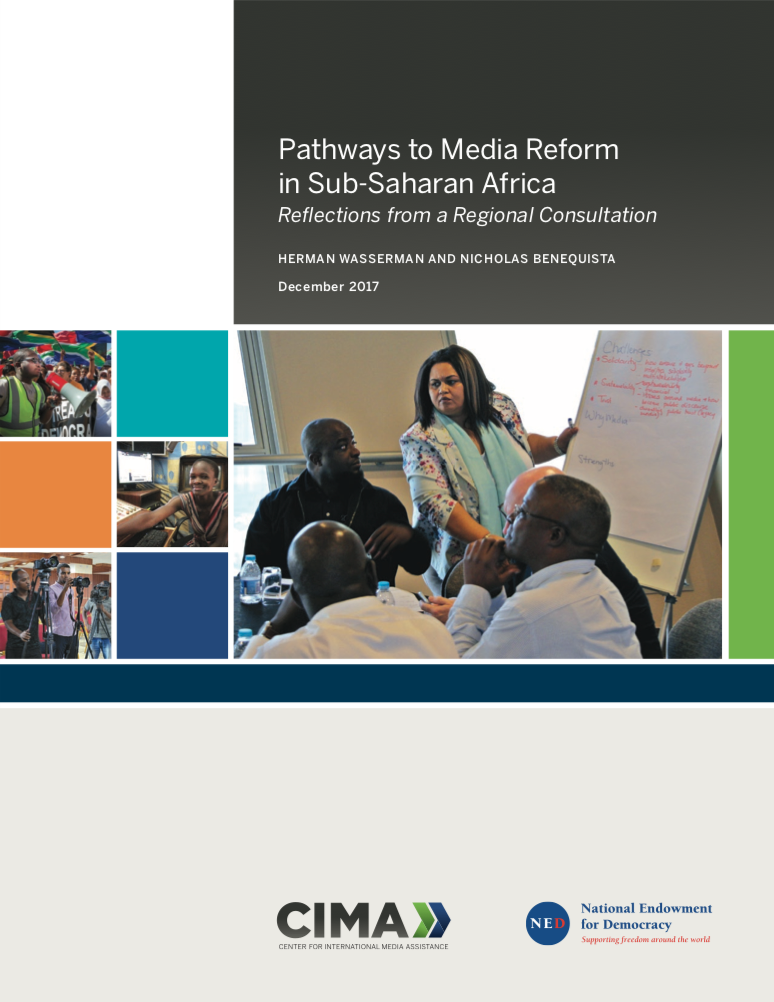
Pathways to Media Reform in Sub‑Saharan Africa: Reflections from a Regional Consultation
REPORT
This report lays out a vision for how the continuing struggle for vibrant, independent, and plural media systems in the region might more effectively bolster efforts of democratic revitalization.
The report draws on the input of 36 experts in media and governance from 15 countries in sub-Saharan Africa who met in Durban, South Africa, in July 2017, and it deepens the insights and ideas that came from this group by documenting previously successful media reforms in sub-Saharan Africa.
[Text sourced from CIMA]
Thumbnail Image: CIMA
The Future of Public Service Broadcasting in Bosnia and Herzegovina
REPORT
This working paper explores the future of public service broadcasting (PSB) in Bosnia and Herzegovina, in light of the complex situation it is currently facing.
Taking into consideration the challenges, development and most recent changes, this research argues that a transformation for a truly PSB in Bosnia and Herzegovina has failed so far in respect to the key elements of a public media system: funding, independence, remit and transition to new technologies.
The publication examines three main points that are relevant to understand PSB in Bosnia and its future prospects. Firstly, it discusses policies development for PSB, how they were adopted and who played a key role in the policy-making processes. Special attention is given to key actors such as the EU, local political elites, and civil society. Secondly, the paper analyzes the political, legal and financial factors that influenced the country’s current situation. Thirdly, the paper examines the way digitisation, convergence, new multimedia platform, and social media influence and change the PSB media system in Bosnia and Herzegovina and its future prospects.
The paper was produced as part of the project “The prospect and development of public service media: Comparative study of PSB development in Western Balkans in light of EU integration“, which is currently exploring the present and future roles and positions of PSB in seven countries across the Western Balkans. The project has been carried out by the Center for Social Research Analitika in partnership with the University of Fribourg.
The Future of Public Service Broadcasting in Serbia
REPORT
This paper examines the status, role, and main challenges of the reform of the public service broadcasting (PSB) in Serbia.
The study address three main research aspects. The first is related to the current operation of the PSB in Serbia, taking into account its regulation, status, model of funding and program quality. The second assesses the entire process of creation of media policies and laws regulating the status of PSB in Serbia, including the actors in those processes, their relations and influence. The final aspect of the research addresses the main challenges of PSB in Serbia with regard to technology innovation and digitalization, use of the new media, and the PSB’s relation with the audience.
The paper was produced within the project “The prospect and development of public service media: Comparative study of PSB development in Western Balkans in light of EU integration” that investigates the position, role, functioning, and the future of public service broadcasters in six countries in the Western Balkans – Albania, Bosnia and Herzegovina, Montenegro, Macedonia, Kosovo and Serbia, taking into account the specific context in which these services developed and the role the European Union played in these processes. The project is implemented by the Center for Social Research Analitika in partnership with the University of Fribourg(link is external).
This project is financed by the Swiss National Science Foundation(link is external), through the SCOPES (Scientific cooperation between Eastern Europe and Switzerland) programme.
[Text by Davor Marko, sourced from the Center for Social Research Analitika]
A comparative analysis of media freedom & pluralism in the EU member states
POLICY BRIEF
Abstract
This study was commissioned by the European Parliament’s Policy Department for Citizens’ Rights and Constitutional Affairs at the request of the LIBE Committee.
The authors argue that democratic processes in several EU countries are suffering from systemic failure, with the result that the basic conditions of media pluralism are not present, and, at the same time, that the distortion in media pluralism is hampering the proper functioning of democracy. The study offers a new approach to strengthening media freedom and pluralism, bearing in mind the different political and social systems of the Member States. The authors propose concrete, enforceable and systematic actions to correct the deficiencies found.