

Public service media, universality and personalisation through algorithms: Mapping strategies and exploring dilemmas
JOURNAL
Hilde Van den Bulck, Hallvard Moe
(2017)
This contribution compares personalisation strategies of public service media (PSM) and how these are reconciled with PSM’s core values, especially universality. To this end, it combines mapping of a sample of PSM with in-depth analysis of Flemish VRT and Norwegian NRK.
Find out more and access the full text via the Sage Journal website. University/Institutional login may be required.
[Text sourced from Sage Journals]

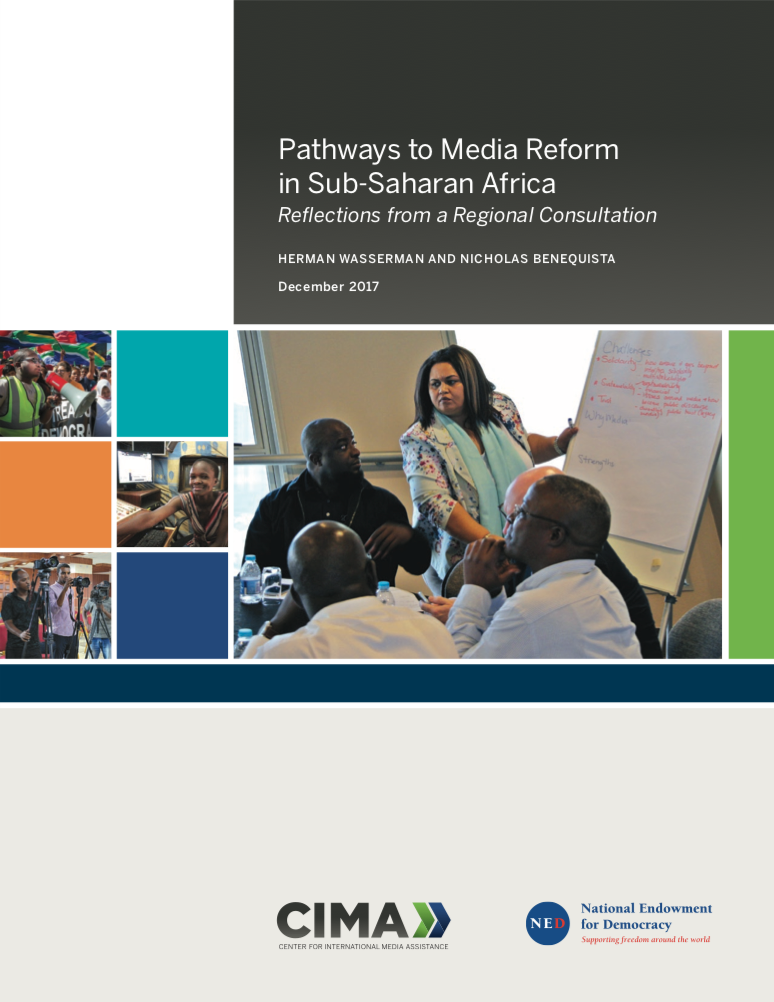
Pathways to Media Reform in Sub‑Saharan Africa: Reflections from a Regional Consultation
REPORT
This report lays out a vision for how the continuing struggle for vibrant, independent, and plural media systems in the region might more effectively bolster efforts of democratic revitalization.
The report draws on the input of 36 experts in media and governance from 15 countries in sub-Saharan Africa who met in Durban, South Africa, in July 2017, and it deepens the insights and ideas that came from this group by documenting previously successful media reforms in sub-Saharan Africa.
[Text sourced from CIMA]
Thumbnail Image: CIMA
In the Service of Power: Media Capture and the Threat to Democracy
REPORT
This brilliant collection of essays explores media capture and the multifaceted threats facing independent journalism, beyond those posed by direct state control.
“In this volume of essays edited by Anya Schiffrin, media capture is shown to be a growing phenomenon linked both to the resurgence of authoritarian governments as well as to the structural weaknesses presently afflicting media markets. In this environment, political figures and economic elites are colluding to undermine the independence of privately-owned media, and efforts to stop this collusion by activists, regulators, and the international community have proven to be ineffective. CIMA is proud to present this collection and hopes it will inspire further research and thoughtful responses to this growing threat to democracies around the world.”
The is book is co-published by the Centre for International Media Assistance (CIMA) and Columbia University’s School of International and Public Affairs.
[Text sourced from CIMA]
Far-Right Nationalism and Populism in Europe: Assaults on Press Freedom
JOURNAL
New research from the University of Vienna shows that growing support for far-right groups and populist politicians poses a severe threat to journalism across Europe.
The report explores the threat posed by far-right groups and populist political figures to press freedom and the watchdog role of independent journalism in 12 European democracies. The report covers the years of 2012-2016, which has been recognised as a period of significant growth in the support of such groups. Countries examined in this timely report include Austria; Bosnia & Herzegovina; Bulgaria; Croatia; France; Germany; Hungary; Italy; Montenegro; Poland; Romania; and Serbia.
The report examines a broad range of criteria that contribute to the term “assault on the media”, including legal action, physical attacks, intimidation verbal and online abuse, the use of employment as leverage and so on.
This timely report concludes by offering recommendations to governments and media owners as to how to best to avoid growing assaults on press freedom by the growth of far right nationalism and populist politics.
The report was published in May 2017 and authored by a team from the Media Governance and Industries Research Lab at the University of Vienna. It was funded by the Erasmus+ Programme of the European Union.
The Future of Public Service Broadcasting in Bosnia and Herzegovina
REPORT
This working paper explores the future of public service broadcasting (PSB) in Bosnia and Herzegovina, in light of the complex situation it is currently facing.
Taking into consideration the challenges, development and most recent changes, this research argues that a transformation for a truly PSB in Bosnia and Herzegovina has failed so far in respect to the key elements of a public media system: funding, independence, remit and transition to new technologies.
The publication examines three main points that are relevant to understand PSB in Bosnia and its future prospects. Firstly, it discusses policies development for PSB, how they were adopted and who played a key role in the policy-making processes. Special attention is given to key actors such as the EU, local political elites, and civil society. Secondly, the paper analyzes the political, legal and financial factors that influenced the country’s current situation. Thirdly, the paper examines the way digitisation, convergence, new multimedia platform, and social media influence and change the PSB media system in Bosnia and Herzegovina and its future prospects.
The paper was produced as part of the project “The prospect and development of public service media: Comparative study of PSB development in Western Balkans in light of EU integration“, which is currently exploring the present and future roles and positions of PSB in seven countries across the Western Balkans. The project has been carried out by the Center for Social Research Analitika in partnership with the University of Fribourg.
The Future of Public Service Broadcasting in Serbia
REPORT
This paper examines the status, role, and main challenges of the reform of the public service broadcasting (PSB) in Serbia.
The study address three main research aspects. The first is related to the current operation of the PSB in Serbia, taking into account its regulation, status, model of funding and program quality. The second assesses the entire process of creation of media policies and laws regulating the status of PSB in Serbia, including the actors in those processes, their relations and influence. The final aspect of the research addresses the main challenges of PSB in Serbia with regard to technology innovation and digitalization, use of the new media, and the PSB’s relation with the audience.
The paper was produced within the project “The prospect and development of public service media: Comparative study of PSB development in Western Balkans in light of EU integration” that investigates the position, role, functioning, and the future of public service broadcasters in six countries in the Western Balkans – Albania, Bosnia and Herzegovina, Montenegro, Macedonia, Kosovo and Serbia, taking into account the specific context in which these services developed and the role the European Union played in these processes. The project is implemented by the Center for Social Research Analitika in partnership with the University of Fribourg(link is external).
This project is financed by the Swiss National Science Foundation(link is external), through the SCOPES (Scientific cooperation between Eastern Europe and Switzerland) programme.
[Text by Davor Marko, sourced from the Center for Social Research Analitika]
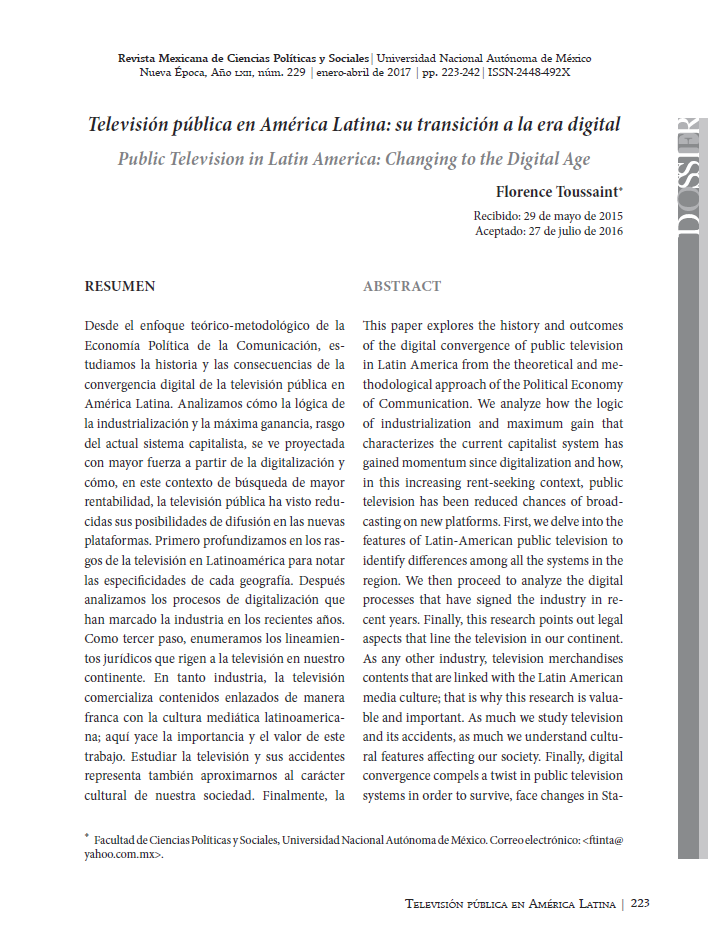
Public Television in Latin America: Changing to the Digital Age
JOURNAL
(Florence Toussaint, published 2017)
This research article tracks the history of public television in Latin America and its journey towards digital transition.
This research briefly explores the history of public television in Latin America, a history that is strongly linked to the government and the political history of each state. Overall, the author highlights that only one public media institution across the region has full editorial independence, financial autonomy or financial support from their viewers. However, television (both public and private) has always held a crucial role in Latin American society as a mediator between the consumption and production of culture.
The birth and growth of public media in Latin America can be traced from the 1950s, but each country evolved differently with regards to growth and the model they chose to transition to the digital world. Countries adopted different digital models, some choosing from the American ATSC (Advanced Television System Commitee), others chose the Japanese-Brazilian ISDB-Tb (Integrated Services Digital Broadcasting-Terrestrial), the European DVB-T (Digital Video Broadcasting-Terrestrial) and the Chinese model.
Some of the data analysed or displayed in the article are not official, but it’s nonetheless useful in highlighting trends and varying situations across the region.
Public television in Latin America continues to be characterised by pluralistic and fragmented media systems and is influenced by just as diverse an array of technologies. Public television will have to transition to the digital world to change and survive especially as quality becomes compromised and viewers head towards new, private options to be entertained, informed and educated.
The complete digitisation of the whole region could take up to 2021, with a few countries already halfway in the process of digitisation.
The full paper and more information can be found below.
(Toussaint Alcaráz, 2017)
Reference: Toussaint Alcaráz, F. (2017) ‘Televisión pública en América Latina: su transición a la era digital’, Revista mexicana de ciencias políticas y sociales, ISSN-e 0185-1918, Vol. 62, No. 229, 2017, págs. 223-242, 62(229), pp. 223–242.
Obeying His Masters’ Voices
JOURNAL
Managing Independence and Accountability in Public Service Media Between Civil Society and State
Christian S. Nissen
Chapter from: Managing Media Firms and Industries
Springer Link
(2016)
Overview
‘Obeying His Masters’ Voices: Managing Independence and Accountability in Public Service Media Between Civil Society and State’ is a chapter from Managing Media Firms and Industries, edited by Gregory Ferrell Lowe and Charles Brown.
The chapter focusses on governance issues of public media organisations, particularly the juggling act of “guarding editorial independence and securing accountability” towards the public, the stakeholders of PSM. This will be explored within the context of maintaining an independent organisation and editorial independence whilst many face growing interference from government.
A comparative analysis of media freedom & pluralism in the EU member states
POLICY BRIEF
Abstract
This study was commissioned by the European Parliament’s Policy Department for Citizens’ Rights and Constitutional Affairs at the request of the LIBE Committee.
The authors argue that democratic processes in several EU countries are suffering from systemic failure, with the result that the basic conditions of media pluralism are not present, and, at the same time, that the distortion in media pluralism is hampering the proper functioning of democracy. The study offers a new approach to strengthening media freedom and pluralism, bearing in mind the different political and social systems of the Member States. The authors propose concrete, enforceable and systematic actions to correct the deficiencies found.
What we do and do not know about the impact of public service media
REPORT
What do we know about the relationship between public media and private media and their respective impacts?
The Reuters Institute for the Study of Journalism (RISJ) has published a new report commissioned by the Danish Ministry of Culture.
The report reviewed the status of public service media and private media by examining over a thousand academic and stakeholders studies. The research covered three main aspects: their political impact, social impact, and market impact.
The research indicates that there is strong evidence that public service media have a positive political impact. However, there is little research on the social and market impacts.
As RISJ says, “what we do not know about the impact of public service media, especially in a digital environment, is at least as striking as what we do know.”